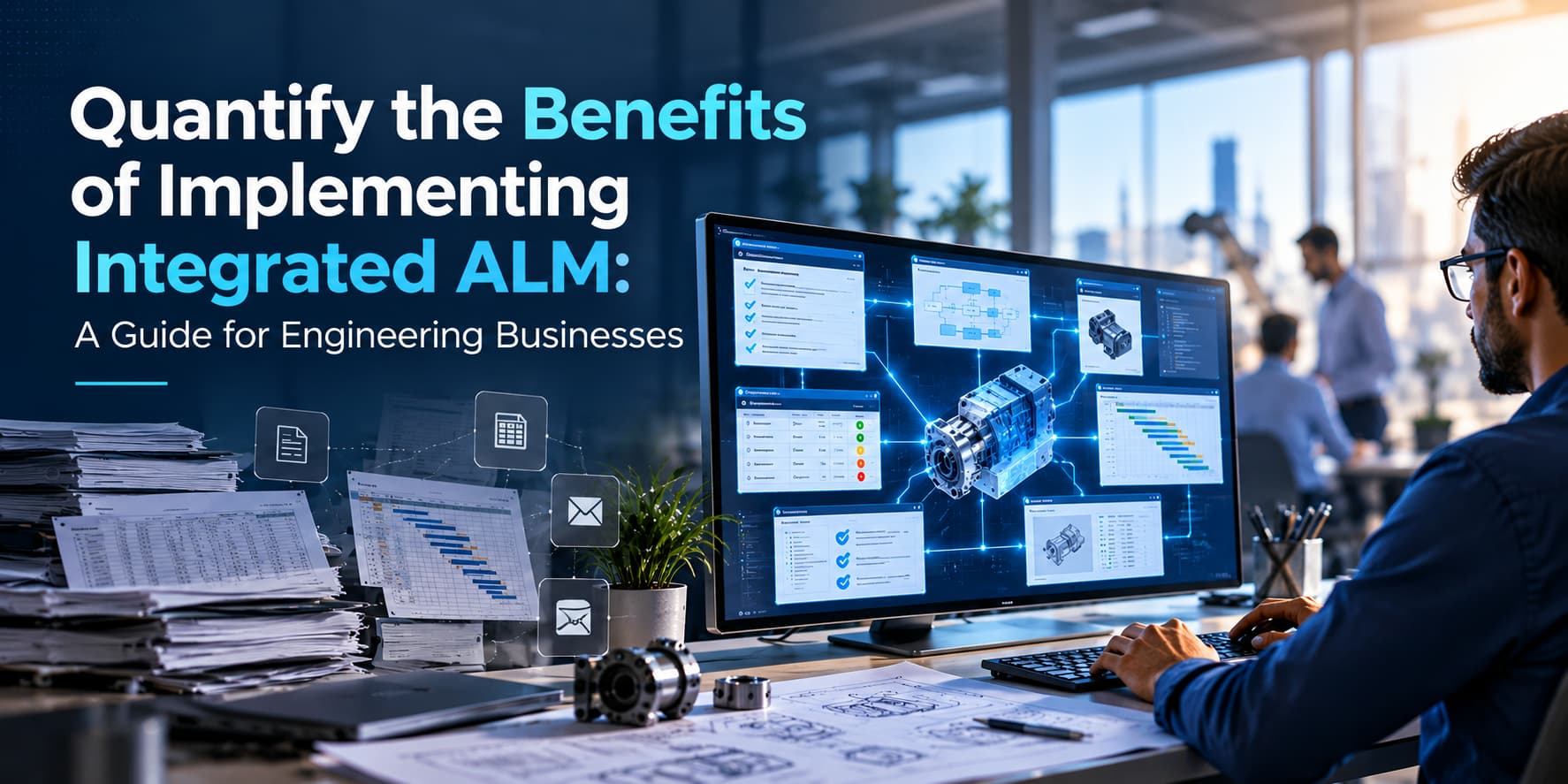
Imagine your engineering team spending hours searching for requirements, updating spreadsheets, tracking defects, and collecting test records from different systems. Projects move forward, but valuable engineering time is lost to manual coordination, repeated work, and disconnected information.
Now imagine connecting these activities through an integrated Application Lifecycle Management (ALM) environment. Requirements, testing, engineering changes, and verification records become easier to manage, helping teams improve efficiency and make better-informed decisions.
But how can you measure the actual business value of integrated ALM?
For engineering-driven organizations, the benefits should go beyond improved collaboration. They should translate into measurable outcomes such as reduced manual effort, less rework, better traceability, improved testing efficiency, and greater project visibility.
With PTC Codebeamer and the right implementation strategy, organizations can establish connected software lifecycle processes and evaluate their impact using meaningful performance indicators.
In this blog, let’s explore how to quantify the benefits of integrated ALM, which metrics to track, and how to build a business case for your ALM investment.
What Is Integrated ALM and Why Does It Matter?
Integrated Application Lifecycle Management connects software requirements, development activities, testing, defect management, risk-related workflows, and change control within a coordinated lifecycle environment.
Instead of managing each activity through disconnected spreadsheets and applications, teams can establish relationships between engineering records and improve visibility across the development process.
For example, when a software requirement changes, engineers need to understand which related requirements, test cases, defects, and verification activities may be affected.
An integrated ALM approach helps teams investigate these relationships without relying entirely on manual searches.
PTC Codebeamer supports requirements management, lifecycle traceability, testing, and collaborative engineering workflows. When appropriately configured, these capabilities can help organizations reduce process inefficiencies and measure improvements in engineering performance.
How Integrated ALM Helps Reduce Engineering Costs
One of the most practical ways to evaluate ALM benefits is to examine how much time engineering teams spend on repetitive administrative activities.
These activities may include:
- Manually maintaining requirements traceability matrices.
- Searching for test results and defect records.
- Preparing project status reports.
- Coordinating requirement changes.
- Collecting documentation for reviews.
- Reconciling information across engineering systems.
When lifecycle information is connected, teams may be able to reduce the effort required for these tasks.
Measure Engineering Time Savings
Consider an engineering team that spends several hours every week on manual lifecycle coordination. If integrated ALM reduces the time required for these activities, the recovered capacity can be redirected toward engineering, testing, and product improvement.
To quantify this benefit, measure the time spent on manual activities before implementation and compare it with the effort required after adoption.
Multiply the verified hours saved by the fully loaded hourly labor cost to estimate the potential capacity value.
For example, if a team saves thirty hours per week and the estimated labor cost is ₹1,000 per hour, the recovered capacity represents ₹30,000 per week.
This is an illustrative calculation, not a guaranteed saving or a PTC performance benchmark. Actual results depend on the organization’s processes, implementation quality, and user adoption.
Want to identify opportunities to reduce engineering effort? Connect with Sumedhas Tech Solutions to explore PTC ALM capabilities for your business.
Reduce Engineering Rework Through Better Traceability
Engineering rework can occur when requirements are misunderstood, changes are not communicated effectively, or dependencies are overlooked.
For complex software-intensive products, correcting these issues may require revisiting requirements, modifying implementation, repeating tests, and updating documentation.
Integrated ALM can help teams maintain relationships between requirements, changes, and verification activities. This supports earlier identification of gaps and more informed engineering decisions.
How to Measure Rework Reduction
Start by identifying how much engineering effort is spent correcting requirement-related issues, resolving missed dependencies, and repeating verification activities.
After implementing an integrated ALM process, track whether these activities require less time.
For example, if an organization records substantial annual rework and improves its processes enough to avoid a portion of that effort, the difference can be converted into an estimated capacity value using internal labor costs.
PTC Codebeamer supports connected requirements and verification workflows that can help teams investigate dependencies and manage changes more effectively.
The actual impact should be established through project data rather than assumed in advance.
Improve Requirements Traceability and Documentation Efficiency
Requirements traceability is particularly important for organizations developing complex products or operating within structured quality and safety processes.
Without reliable traceability, engineers may need to search multiple documents to determine whether requirements have been implemented and verified.
Integrated ALM can help maintain relationships between requirements, test cases, defects, and related engineering records.
Which Traceability Metrics Should You Track?
Requirements traceability coverage: Measure the percentage of applicable requirements with the required verification links.
Change impact analysis time: Track how long engineers take to identify affected requirements, tests, and documentation after a change request.
Documentation preparation effort: Measure the time needed to collect and validate requirements, approvals, test records, and supporting evidence.
Review readiness: Monitor whether required lifecycle records are available and complete when engineering reviews take place.
PTC Codebeamer supports traceability workflows that can help organizations establish these relationships and improve lifecycle visibility.
However, the value depends on how well requirements and relationships are configured, maintained, and reviewed.
Improve Testing Efficiency With Integrated ALM
Testing is essential to software quality, but its effectiveness depends on more than the number of tests executed. Teams also need to understand coverage, defect status, and whether changed requirements have been adequately verified.
Disconnected requirements and test records can make it difficult to identify missing coverage or determine whether a change requires additional testing.
An integrated ALM environment helps teams connect test cases with requirements and record execution results and defects in a structured way.
Testing KPIs Worth Measuring
- Requirements verification coverage: The proportion of applicable requirements with the required verification links or evidence.
- Test execution rate: The percentage of planned tests completed within a defined period.
- Defect resolution time: The average time between defect identification and resolution.
- Defect reopening rate: The percentage of resolved defects reopened for further work.
- Escaped defects: Defects discovered after the relevant testing stage or release.
These metrics should be interpreted together. Executing more tests does not necessarily mean software quality has improved if important requirements remain unverified.
PTC Codebeamer can help teams connect requirements, testing, and defects, improving visibility into verification status and outstanding issues.
Accelerate Change Impact Analysis
Changes are inevitable during software development. A revised customer requirement, an updated interface specification, or a discovered defect may affect several engineering activities.
When dependency information is difficult to access, assessing the impact of a change can consume valuable engineering time.
Integrated ALM helps teams investigate relationships between lifecycle records and identify which items may require review.
To quantify this benefit, measure the average time required to assess change requests before and after implementing connected lifecycle workflows.
Even a modest reduction in the time required for each assessment can create meaningful capacity improvements when changes occur frequently.
PTC Codebeamer supports traceability and change management workflows that can help engineering teams make more informed decisions about affected requirements and verification activities.
Improve Project Visibility and Release Readiness
Engineering leaders need reliable information about outstanding requirements, testing status, defects, and unresolved changes.
When information is spread across disconnected systems, reporting often depends on manual updates and individual interpretations.
Integrated ALM can provide a more connected view of lifecycle information, helping teams assess project progress and identify issues that may affect release readiness.
Useful indicators include overdue requirements, open defects, verification coverage, outstanding change requests, and the time required to prepare project reports.
These indicators help teams identify bottlenecks and make decisions using more consistent information.
Improved visibility does not automatically guarantee shorter release cycles. Delivery performance also depends on engineering capacity, technical complexity, external dependencies, and decision-making processes.
How to Calculate the ROI of Integrated ALM
To determine whether an integrated ALM investment makes financial sense, compare the verified benefits with the full cost of implementation.
Potential benefits may include:
- Reduced manual coordination effort.
- Lower engineering rework.
- Faster change impact analysis.
- Less time spent preparing documentation.
- Improved use of testing resources.
- Better visibility into engineering risks.
The total investment should account for PTC software licensing, implementation, configuration, integration, data migration, training, and ongoing support.
Why Choose Sumedhas Tech Solutions for PTC ALM Solutions?
Quantifying ALM benefits begins with understanding your existing engineering processes and identifying where time, effort, and visibility are being lost.
Sumedhas Tech Solutions is an authorized PTC PLM license provider and offers services to help organizations explore relevant PTC solutions.
For businesses evaluating PTC Codebeamer, Sumedhas Tech Solutions can help you discuss your engineering requirements, explore applicable licensing options, and understand relevant service needs.
What to Evaluate Before Implementing PTC ALM
A practical ALM evaluation should consider:
- Your current requirements and traceability processes.
- The effort spent on manual reporting and change analysis.
- Testing and defect management challenges.
- Integration requirements.
- Implementation and training needs.
- The performance indicators that will demonstrate improvement.
Establishing baseline metrics before implementation helps organizations evaluate whether the chosen approach delivers measurable operational value.
Ready to evaluate PTC ALM for your business? Contact Sumedhas Tech Solutions to discuss your engineering challenges and explore suitable PTC licensing and service options.
Turn Integrated ALM Benefits Into Measurable Business Value
Integrated ALM can help engineering organizations improve traceability, reduce manual coordination, manage changes more effectively, and gain better visibility into testing and project progress.
However, the business case should be based on measurable outcomes rather than assumptions. Establish a baseline, identify the processes that consume the most effort, set realistic improvement targets, and evaluate the results after implementation.
PTC Codebeamer provides capabilities that support requirements management, traceability, testing, and collaborative engineering workflows. With a clear implementation strategy, organizations can assess how these capabilities contribute to their operational objectives.
Partner with Sumedhas Tech Solutions to explore PTC ALM solutions for your engineering needs.
Request a consultation to discuss your requirements, explore licensing options, and identify the performance indicators that matter most to your organization.
Contact Sumedhas Tech Solutions today to start building your integrated ALM business case.
Frequently Asked Questions About Integrated ALM Benefits
How Do You Measure the Benefits of Integrated ALM?
Measure performance before and after implementation using indicators such as engineering hours saved, rework effort, traceability coverage, change analysis time, defect resolution time, and reporting effort.
Can Integrated ALM Reduce Engineering Costs?
Integrated ALM can help reduce manual effort and rework, potentially creating financial value. Actual savings depend on implementation quality, adoption, process maturity, and how recovered capacity is used.
How Does PTC Codebeamer Improve Traceability?
PTC Codebeamer supports requirements management and lifecycle traceability, helping teams connect requirements with testing and related engineering records.
What Is a Good ROI for an ALM Implementation?
There is no universal ROI target. Organizations should calculate ROI using verified benefits and the complete cost of licensing, implementation, integration, training, and ongoing support.
How Can Sumedhas Tech Solutions Help With PTC ALM?
Sumedhas Tech Solutions can help organizations explore relevant PTC licensing options and available services, and discuss how PTC ALM capabilities may align with their engineering requirements.
You must be logged in to post a comment.