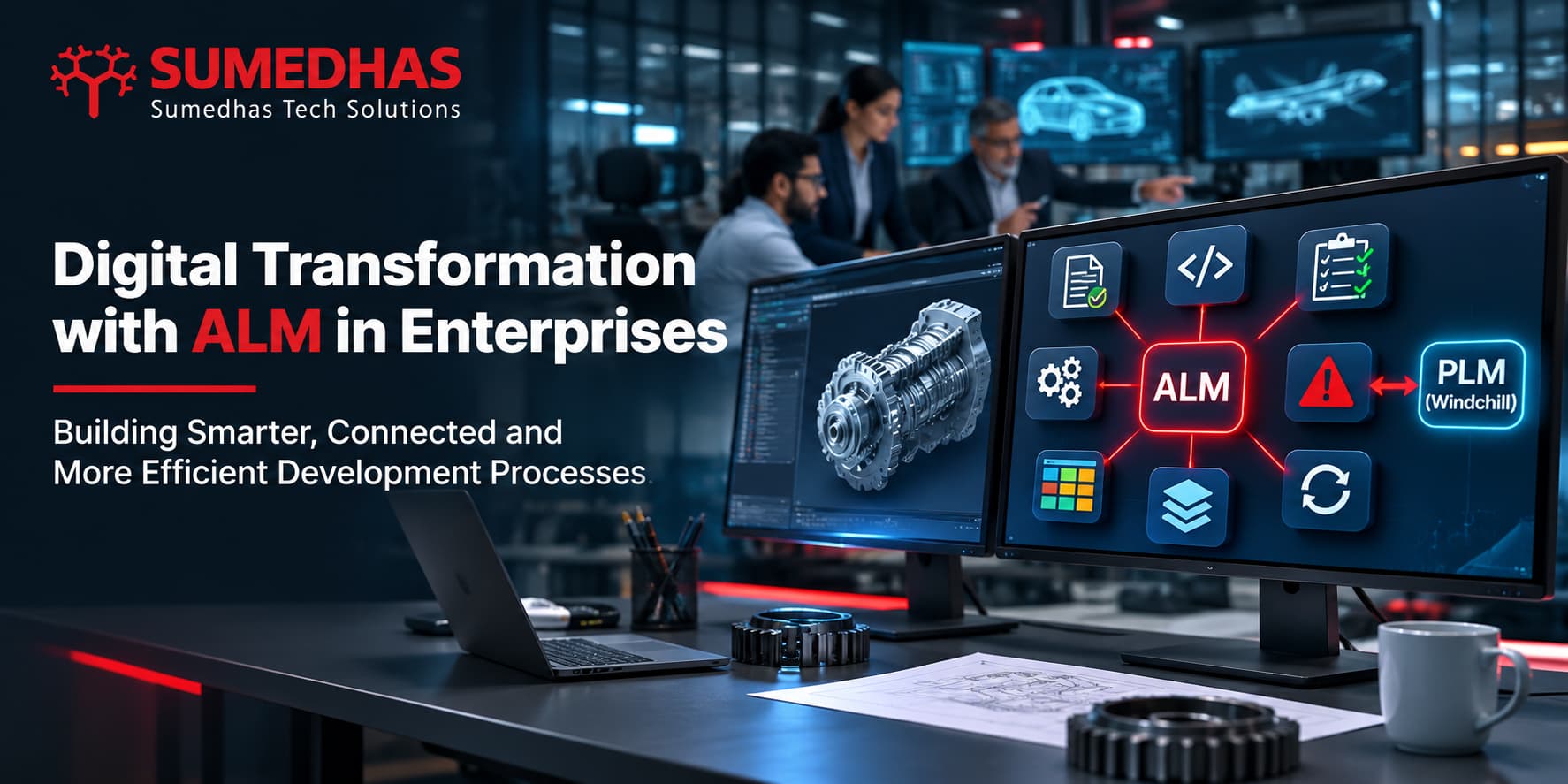
Imagine your engineering team is working on a critical product release. The software development team has updated the code, the testing team is working with an older set of requirements, and the project manager is still waiting for confirmation on a design change. Important information is scattered across spreadsheets, emails and separate software applications.
The result? Delayed decisions, repeated work, overlooked requirements and increased project risks.
For enterprises developing complex, software-driven products, these challenges can affect everything from engineering productivity to product quality and regulatory compliance.
This is where Application Lifecycle Management (ALM) becomes an important part of enterprise digital transformation.
ALM helps organisations bring requirements, development activities, testing, risk management and project information into a more connected and controlled environment. Instead of managing each activity independently, enterprises can establish better visibility and coordination across the application development lifecycle.
With the growing complexity of connected products, embedded software and digital engineering processes, implementing the right ALM strategy is becoming increasingly important.
So, how can enterprises approach digital transformation with ALM, and what role can platforms such as PTC Codebeamer play?
Let’s explore.
What Is Application Lifecycle Management (ALM), and Why Does It Matter for Enterprises?
Application Lifecycle Management (ALM) is the structured management of an application’s lifecycle, from initial requirements and planning through design, development, testing, deployment and ongoing maintenance.
It brings together people, processes, tools and information involved in application development.
For enterprises, ALM is not simply about managing software development tasks. It is about establishing a connected approach where every team understands what needs to be developed, why it is required, how it should be validated and whether the final deliverable meets the defined expectations.
A comprehensive ALM approach typically includes:
- Requirements management.
- Software development management.
- Test planning and execution.
- Risk management.
- Change and configuration management.
- Agile project management.
- Quality assurance.
- Compliance and documentation.
- End-to-end traceability.
- Collaboration across development teams.
Consider an automotive company developing an advanced driver assistance feature. Its development involves software engineers, system architects, testing specialists, quality teams and safety professionals.
Each team contributes different information, but all activities must remain connected to the original requirements.
An ALM platform helps establish these connections, making it easier to track progress, identify gaps and understand the impact of changes.
Looking to understand how ALM can fit into your enterprise development processes?: Request an ALM Consultation
Why Is Digital Transformation with ALM Important for Enterprises?
Digital transformation requires more than introducing new software applications. Enterprises must also examine how their teams collaborate, manage information, handle changes and maintain quality.
Many organisations continue to experience operational difficulties because their development processes rely on disconnected systems and manual coordination.
Here are some common challenges that make ALM adoption valuable.
1. Disconnected Development Tools and Information Silos
Development teams often use different applications for requirements, coding, testing, project management and documentation.
When these systems operate independently, information becomes difficult to consolidate.
For example, a software developer may complete a change without the testing team receiving the latest requirement updates. Similarly, project managers may struggle to understand the actual status of development activities.
How ALM helps: A connected ALM environment brings development-related information together and establishes relationships between different work items. This improves visibility and reduces dependence on scattered communication.
2. Lack of End-to-End Requirements Traceability
Requirements can change throughout a development project. Without proper tracking, teams may struggle to determine whether every requirement has been implemented and tested.
Missing traceability can also create difficulties during audits and compliance reviews.
How ALM helps: Requirements can be linked with development activities, test cases, defects and verification results. Teams can follow the relationship between an original requirement and its corresponding implementation and validation evidence.
3. Increasing Project Complexity
Enterprise projects often involve multiple teams, locations, software components and stakeholders.
Managing dependencies manually can become difficult, especially when several development activities happen simultaneously.
How ALM helps: Structured workflows, task management, shared information and project visibility help teams coordinate activities more effectively.
4. Difficulties in Managing Engineering Changes
A small requirement change can affect software architecture, development tasks, test cases and documentation.
Without a structured change management process, teams may overlook dependencies or continue working with outdated information.
How ALM helps: ALM platforms support controlled change processes and impact analysis, helping organisations identify affected requirements, work items and tests before implementing changes.
5. Quality and Compliance Concerns
Enterprises developing products for regulated industries must maintain suitable documentation, verification evidence and traceability.
Relying on manually maintained records can increase administrative effort and make it harder to establish a consistent audit trail.
How ALM helps: Centralised records, structured workflows and linked requirements and testing information help organisations maintain better visibility into quality and compliance activities.
How Does ALM Support Enterprise Digital Transformation?
An effective ALM strategy connects development activities that are often managed separately.
Rather than treating requirements, development, testing and maintenance as independent functions, enterprises can establish a coordinated lifecycle.
Here are some important ways ALM supports this transformation.
1. Centralised Requirements Management
Requirements form the foundation of every development project.
ALM enables teams to capture, organise, review and track requirements in a structured environment.
This helps organisations:
- Maintain a common understanding of project expectations.
- Track requirement changes.
- Assign ownership and responsibilities.
- Identify incomplete or conflicting requirements.
- Connect requirements with testing and development activities.
When everyone works with consistent requirement information, the possibility of misunderstandings and avoidable rework can be reduced.
2. Improved Collaboration Across Teams
Enterprise development involves several departments with different responsibilities.
ALM helps create a shared working environment where authorised stakeholders can access relevant project information.
Developers can understand assigned requirements, testers can access corresponding test cases, and project managers can review progress through structured workflows.
This reduces information gaps and supports better coordination.
3. Better Test Management and Quality Assurance
Testing should not be treated as an isolated activity performed only at the end of development.
ALM allows organisations to connect test planning, test execution, defects and verification activities with their requirements.
This helps teams:
- Plan test activities systematically.
- Track test execution status.
- Identify failed test cases.
- Connect defects with relevant requirements.
- Review test coverage.
- Maintain testing evidence.
By connecting quality activities throughout development, organisations can identify issues earlier and improve confidence in product releases.
4. Structured Risk Management
Identifying risks at an early stage is important, particularly when products involve complex software or safety-related functions.
ALM platforms can support risk analysis, mitigation planning and the relationship between identified risks and relevant requirements or verification activities.
This gives teams a more organised way to monitor potential issues and their resolution.
5. Better Change and Configuration Management
Enterprise development rarely follows a completely fixed plan.
Requirements evolve, defects are identified, features are revised and different product versions may require different configurations.
ALM provides structured processes for recording and managing these changes.
This helps teams understand what has changed, why it changed and which development or testing activities may be affected.
Key Benefits of Implementing ALM Software in Enterprises
Implementing ALM can offer benefits beyond software development management.
When aligned with business objectives and supported by appropriate processes, it can help enterprises improve operational visibility, development governance and product quality.
The following are some important benefits.
1. Greater Process Visibility
A centralised view of requirements, development tasks, test activities and project status helps decision-makers understand ongoing work.
2. Improved Requirements Traceability
Connecting requirements with implementation and verification activities makes it easier to identify gaps and demonstrate coverage.
3. Reduced Manual Coordination
Structured workflows and connected information can reduce the effort spent searching for updates across emails, spreadsheets and separate systems.
4. Better Change Management
Teams can assess the potential impact of changes before proceeding, helping avoid overlooked dependencies.
5. Stronger Quality Management
Connecting requirements, tests and defects provides better visibility into validation activities and unresolved issues.
6. Improved Compliance Readiness
Organised documentation, traceability and controlled workflows can support evidence collection and compliance-related activities.
7. More Informed Decision-Making
Managers can use structured project information to identify bottlenecks, monitor progress and prioritise actions.
8. Better Alignment Between Business and Engineering Teams
A common view of project requirements and development progress helps connect technical activities with organisational objectives.
The benefits achieved depend on implementation quality, process maturity, user adoption and how effectively ALM is integrated with the enterprise’s existing technology environment.
Why PTC Codebeamer Is an Important ALM Platform for Enterprises
Selecting an appropriate ALM platform is an important decision for organisations dealing with complex software development and product engineering requirements.
PTC Codebeamer is an ALM platform designed to support advanced product and software development.
It provides capabilities for requirements management, risk management, test management, Agile project management and end-to-end traceability.
For enterprises working with complex products, Codebeamer can help connect development activities and maintain relationships between requirements, risks, tests and other engineering information.
Key PTC Codebeamer Capabilities
1. Requirements Management
Codebeamer helps teams capture, organise and manage requirements throughout the development lifecycle.
Requirements can be linked with relevant tasks, tests and other work items, improving visibility into project coverage.
2. Risk Management
Organisations can manage risk-related information, assessments and mitigation activities alongside requirements and verification processes.
This is particularly relevant for teams working on complex and safety-sensitive applications.
3. Test Management
Codebeamer supports test planning, test case management, execution tracking and test coverage analysis.
Teams can connect test cases with requirements and review whether the defined expectations have been validated.
4. End-to-End Traceability
One of the important capabilities of Codebeamer is its ability to establish relationships between requirements, risks, tests and development activities.
This helps teams understand dependencies and assess the impact of changes.
5. Agile Project Management
Codebeamer supports Agile approaches, including Scrum and Kanban, along with other development methodologies.
Teams can manage backlogs, tasks, releases and development activities through structured workflows.
6. Integration Capabilities
Codebeamer can connect with other development and engineering tools, including Git-based repositories, Jira and Windchill, helping organisations establish a more connected development environment.
7. Configurable Workflows
Enterprises can configure processes and workflows according to their project requirements and organisational practices.
This flexibility is valuable when different teams follow different development processes.
These capabilities make Codebeamer relevant for organisations looking to improve control over complex software and product development activities.
How ALM Works Across Different Enterprise Industries
ALM is relevant to organisations where software development, product complexity, quality assurance and requirements management are closely connected.
Its applications vary depending on the industry’s technical and regulatory requirements.
1. Automotive Industry
Modern vehicles contain multiple interconnected software systems, including vehicle control applications, infotainment systems and driver assistance technologies.
An automotive engineering team developing a vehicle safety feature must manage functional requirements, software changes, test cases and verification evidence.
ALM helps connect these activities and maintain traceability across development and validation.
2. Aerospace and Defence
Aerospace and defence projects involve complex systems, extensive documentation and stringent verification requirements.
Development teams must understand how requirements translate into system behaviour and how each requirement is validated.
ALM can help maintain structured requirement relationships, risk records, testing information and compliance-related evidence.
3. Medical Devices
Medical device development involves software functionality, product safety, risk assessment and documented verification activities.
For example, a team developing software for a medical monitoring device needs to establish connections between product requirements, identified risks, development activities and test results.
An ALM platform can support these relationships and improve the organisation of development evidence.
4. Industrial and High-Tech Products
Industrial equipment and electronic products increasingly combine hardware, software and connected functionalities.
Teams must coordinate software releases, system requirements, testing and product changes.
ALM supports this coordination by connecting engineering activities and providing better visibility into development progress.
5. Electronics and Embedded Systems
Embedded software development often involves multiple hardware and software dependencies.
ALM helps teams organise requirements, manage versions, track defects and connect testing activities with the intended system behaviour.
What Challenges Should Enterprises Consider Before ALM Implementation?
Introducing ALM software without preparing the organisation can lead to adoption difficulties.
A successful implementation requires attention to business processes, existing tools, user requirements and long-term support.
Here are some common challenges enterprises should address.
1. Unclear Business Requirements
Organisations sometimes select software before defining what they actually need.
This can lead to unnecessary customisation and process complications.
Recommended approach: Identify existing development challenges, process gaps and desired business outcomes before selecting an ALM solution.
2. Resistance to Process Changes
Employees who are comfortable with existing spreadsheets and applications may find it difficult to adopt new workflows.
Recommended approach: Involve relevant stakeholders early, explain the purpose of the implementation and provide appropriate training.
3. Integration with Existing Applications
Enterprises may already use several tools for software development, testing, project management and product data.
Connecting these systems requires careful planning.
Recommended approach: Assess integration requirements and define the information that needs to move between applications.
4. Migration of Existing Data
Moving requirements, test records, documents and historical information into a new ALM environment can be challenging.
Recommended approach: Establish a data migration strategy that includes data mapping, validation, ownership and quality checks.
5. Excessive Customisation
Customising every workflow to match existing practices can increase implementation complexity.
Recommended approach: Begin with essential processes, evaluate standard platform capabilities and customise only where there is a clear business requirement.
6. Lack of Ongoing Technical Support
ALM implementation is not a one-time activity. Organisations may need configuration changes, user assistance, integrations and platform upgrades.
Recommended approach: Work with an experienced technology partner that can support the platform beyond initial deployment.
How to Choose the Right ALM Implementation Partner for Your Enterprise
The technology platform is only one part of an effective ALM strategy.
The implementation partner plays an equally important role in ensuring that the solution aligns with your enterprise processes and technical requirements.
Before selecting a partner, consider the following factors:
- Platform expertise: Does the partner understand the selected ALM platform and its capabilities?
- Implementation experience: Can the team plan and execute an implementation based on enterprise requirements?
- Process consulting: Can the partner assess your existing workflows and recommend improvements?
- Integration expertise: Can they connect ALM with your existing engineering and development applications?
- Migration capabilities: Can they assist with transferring existing data and validating its accuracy?
- Customisation and configuration: Can they adapt the platform to your organisational requirements?
- Technical support: Will assistance be available after deployment?
- Training and enablement: Can the partner help your employees understand and adopt the new system?
A capable implementation partner should focus not only on software deployment but also on helping your organisation establish sustainable development processes.
How Sumedhas Tech Solutions Supports Enterprise ALM and Digital Transformation
Choosing the right technology partner can make a significant difference when planning and implementing enterprise ALM solutions.
Sumedhas Tech Solutions Pvt. Ltd. is a technology organisation specialising in the New Product Development domain, providing solutions and services across CAD, CAM, CAE, PLM, ALM and SLM.
As an authorised PTC licensing provider and PTC Systems Integrator services partner, Sumedhas supports organisations in evaluating, implementing and managing technology solutions aligned with their business and engineering requirements.
1. Authorised PTC ALM Licensing
Sumedhas helps enterprises explore and procure genuine PTC software licences based on their business requirements.
Whether your organisation is evaluating an ALM platform for the first time or planning to expand its existing software environment, the team can help you understand relevant licensing options.
Enquire About PTC ALM Licensing
2. ALM Consulting and Process Assessment
Every organisation has different development workflows, technology environments and business objectives.
Sumedhas can help assess existing processes, identify areas that require improvement and evaluate suitable ALM approaches.
The focus is on understanding your requirements before recommending an implementation strategy.
3. ALM Implementation Services
Selecting an ALM platform is only the beginning.
Implementation requires planning, configuration and alignment with organisational workflows.
Sumedhas provides implementation-related services to help enterprises establish ALM environments that support their development processes and technical requirements.
4. ALM Integration Services
Enterprises often use multiple applications for development, product data, testing and collaboration.
Sumedhas supports integration-related requirements to help organisations connect their engineering systems and improve information flow.
For example, connecting ALM and PLM environments can help establish relationships between software requirements and product engineering information.
5. Upgrade, Migration and Application Support
Existing ALM environments may require upgrades, data migration, configuration improvements and ongoing technical support.
Sumedhas provides technology services to help organisations manage these activities and maintain their application environments.
6. PLM and ALM Expertise
Enterprise product development involves both hardware and software engineering.
While ALM helps manage software requirements, development, testing and related activities, PLM manages product information and lifecycle processes.
Sumedhas offers expertise across both domains, helping organisations evaluate how ALM and PLM can work together to support connected engineering workflows.
Why Consider Sumedhas Tech Solutions?
- Authorised PTC licensing provider.
- PTC Systems Integrator services partner.
- Expertise across ALM, PLM, CAD, CAM, CAE.
- ALM and PLM consulting capabilities.
- Implementation, integration and migration services.
- Application support and technical assistance.
- Experience across automotive, aerospace and high-tech industries.
Whether you are planning a new ALM implementation, evaluating PTC Codebeamer or looking to improve an existing engineering technology environment, Sumedhas can help you assess the appropriate approach.
Planning an ALM implementation for your enterprise? Contact Sumedhas Tech Solutions for a discussion about your requirements.
ALM and PLM: Why Should Enterprises Consider Both?
ALM and PLM are often discussed together because modern product development involves both software and physical product engineering.
However, they address different aspects of the product development process.
Application Lifecycle Management (ALM) focuses on managing software requirements, development, testing, defects, risks and releases.
Product Lifecycle Management (PLM) focuses on managing product-related information, engineering data, configurations, changes and product lifecycle processes.
For example, an organisation developing a connected industrial product may use PLM to manage mechanical designs, product structures and engineering documents, while ALM manages the embedded software requirements, code-related activities and test cases.
When these environments are connected appropriately, teams can establish better visibility across hardware and software development.
PTC Codebeamer and Windchill can support this connected approach through integration capabilities, helping organisations establish relationships between software engineering information and product lifecycle data.
For enterprises developing complex, software-driven products, evaluating both ALM and PLM can be an important part of their digital transformation strategy.
Transform Your Enterprise Development Processes with the Right ALM Strategy
Disconnected requirements, limited project visibility, complex testing activities and unstructured change management can create significant challenges for enterprise development teams.
A well-planned ALM strategy helps organisations bring these activities together, improve traceability and establish better coordination across the application development lifecycle.
With platforms such as PTC Codebeamer, enterprises can create structured workflows for requirements, risks, testing and development management while connecting relevant engineering systems.
However, achieving the intended benefits requires more than selecting a software licence. It involves understanding your business processes, planning the implementation, integrating existing applications and supporting employees throughout the transition.
Sumedhas Tech Solutions can help your organisation take a structured approach to enterprise ALM through authorised PTC licensing, consulting, implementation, integration, migration and application support services.
Ready to Explore ALM for Your Enterprise?
Whether you are considering PTC Codebeamer, planning a new ALM implementation or looking to improve your existing development environment, the first step is understanding what your organisation needs.
Book a Free ALM Consultation with Sumedhas Tech Solutions.
Discuss your current development challenges, explore relevant PTC ALM capabilities and understand how an implementation strategy can align with your enterprise objectives.
Get in touch today:
Website: Sumedhas Tech Solutions
Email: info@sumedhastech.com
Phone: +91 70224 24601 | +91 90086 69121
Sumedhas Tech Solutions – Your Technology Partner for ALM, PLM and Enterprise Engineering Solutions.
Frequently Asked Questions About Enterprise ALM and Digital Transformation
1. What Are the Main Benefits of ALM Software for Enterprises?
ALM software can improve requirements traceability, collaboration, project visibility, test management, change control, risk management and compliance-related documentation.
2. What Is PTC Codebeamer Used For?
PTC Codebeamer is an ALM platform used to manage requirements, software development activities, risks, testing, Agile processes and end-to-end traceability across complex product and software development projects.
3. How Does ALM Improve Requirements Traceability?
ALM connects requirements with associated development activities, test cases, defects and verification information. This helps teams track whether requirements have been addressed and validated.
4. Is ALM Useful for Automotive and Aerospace Enterprises?
Yes. ALM can support automotive and aerospace organisations by helping manage complex software requirements, testing activities, risk information, traceability and compliance-related evidence.
5. Can ALM Integrate with PLM Software?
Yes. ALM platforms such as Codebeamer can integrate with PLM environments such as Windchill. Such integrations can connect software engineering information with product-related data and improve cross-functional visibility.
You must be logged in to post a comment.