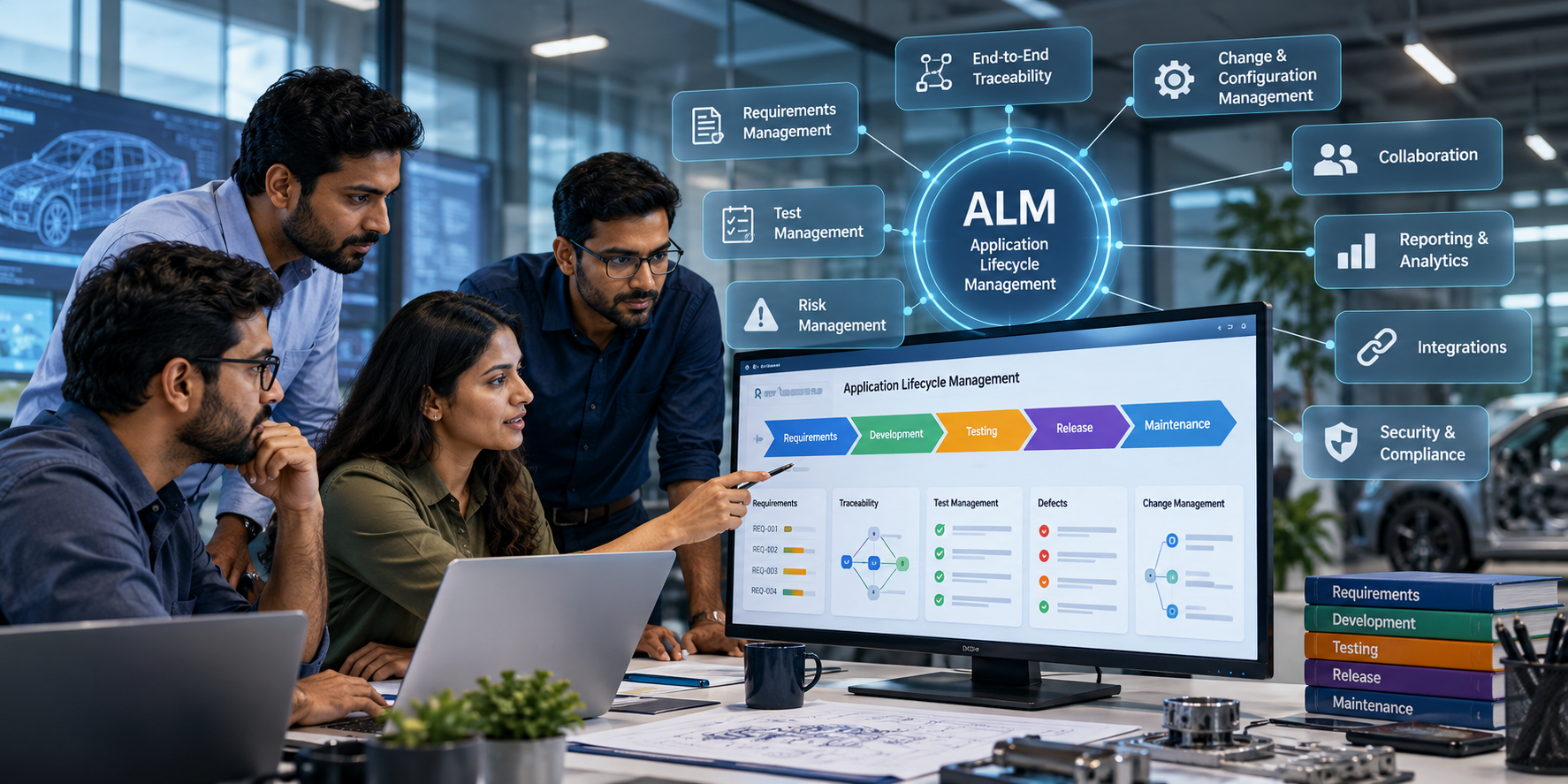
A requirement changes. The development team does not see it immediately. A test case is updated in another system. A defect is tracked somewhere else. Then, when someone asks, “Which requirement does this test actually validate, and what else will be affected if we change it?”, the team starts searching through spreadsheets, emails, documents, tickets, and disconnected tools.
This is where Application Lifecycle Management, or ALM, becomes important.
For organizations developing software-intensive products, managing individual tasks is not enough. Teams need to connect requirements, development activities, risks, testing, defects, changes, approvals, and releases so that everyone can understand what is happening across the lifecycle.
PTC describes ALM as a discipline that manages the lifecycle from initial idea and requirements through design, development, testing, deployment, maintenance, and end of life. Its current ALM portfolio includes capabilities around requirements, risk, testing, traceability, collaboration, compliance, analytics, and development processes.
But choosing an ALM platform is not simply about selecting the tool with the longest feature list. The real question is: Which features will solve the problems your engineering and product teams are actually facing?
For companies evaluating ALM solutions, this guide explains the top features to look for in an ALM platform, why each feature matters, common implementation challenges, and how an experienced PTC PLM and ALM partner such as Sumedhas Tech Solutions can help organizations evaluate and implement the right solution.
What Is an ALM Platform and Why Do Companies Need One?
An ALM platform provides a structured environment for managing the activities and information associated with software and product development throughout the lifecycle.
In a simple development setup, a team may manage requirements in documents, development tasks in a project management application, test cases in spreadsheets, defects in another application, and approvals through email. Each tool may work reasonably well, but the connections between them become difficult to maintain.
As product complexity increases, these disconnected processes create practical problems. A requirement may be modified without the corresponding test being reviewed. A defect may not be clearly connected to the requirement that exposed it. A stakeholder may be looking at an older version of a specification. During an audit, the team may have to manually collect evidence from several systems.
An ALM platform addresses this by connecting lifecycle information and providing greater visibility into relationships between requirements, risks, tests, changes, and development activities.
For complex products, this connection is particularly important. PTC notes, for example, that a single vehicle can involve 30,000 to 50,000 requirements, illustrating the scale of information that teams may need to organize and trace.
Managing requirements, testing, and changes across multiple disconnected tools? Talk to Sumedhas Tech Solutions about an ALM assessment for your current development process.
What Are the Most Important Features of an ALM Platform?
Not every organization needs exactly the same ALM capabilities. However, there are several core features that should be considered when evaluating an enterprise ALM platform.
These include requirements management, end-to-end traceability, test management, risk management, change and configuration management, workflow automation, collaboration, reporting, integrations, security, compliance support, and scalability.
The right platform should bring these capabilities together without forcing teams to create complicated workarounds every time a requirement or product configuration changes.
1. Requirements Management Should Be at the Core of the ALM Platform
Requirements are the foundation of a development project. If requirements are unclear, duplicated, outdated, or disconnected from development and testing, problems can spread throughout the project.
A strong ALM platform should allow teams to capture, organize, structure, review, approve, version, and track requirements throughout the lifecycle.
It should also support different types of requirements, including high-level business or stakeholder requirements and more detailed system or software requirements. Teams should be able to establish relationships between these levels so that they can understand how a high-level need is translated into specific implementation requirements.
PTC highlights requirements authoring, visibility, metrics, traceability, change management, configuration management, reuse, verification, validation, and compliance as important requirements-management capabilities.
What problem does strong requirements management solve?
Consider an automotive engineering team that receives a change to a software requirement related to a safety function. Without structured requirements management, the team may update the specification but overlook related test cases or downstream requirements.
With an ALM system, the requirement can be connected to related artifacts, making it easier to identify what needs review when a change occurs.
This is one of the most important reasons to evaluate requirements management carefully when selecting an ALM platform.
2. End-to-End Traceability Is Essential for Complex Development
If there is one feature that deserves particular attention during an ALM evaluation, it is traceability.
Traceability creates relationships between lifecycle artifacts. Depending on the organization and process, these relationships can connect requirements to risks, design information, development items, test cases, defects, and validation results.
Instead of asking teams to manually prove how one artifact relates to another, the ALM platform can provide a connected view.
PTC describes end-to-end traceability as a way to connect requirements through implementation and testing, while its current ALM solutions emphasize traceability across requirements, risks, tests, and other lifecycle information.
Why does traceability matter during a requirement change?
Imagine that a customer requirement changes after development has already started.
The immediate question is not simply whether the requirement can be edited. The engineering team needs to know:
- Which lower-level requirements are affected?
- Which development items need review?
- Which test cases need modification?
- Which risks are associated with the requirement?
- Which defects or validation activities could be impacted?
- Which product versions or configurations contain the affected functionality?
A good ALM platform should make this impact analysis significantly easier.
Need better visibility into requirement-to-test traceability? Sumedhas Tech Solutions can help evaluate how an ALM solution can fit into your existing engineering workflow.
3. Test Management Should Connect Testing Directly to Requirements
Testing cannot be treated as an isolated activity at the end of development.
An effective ALM platform should allow teams to create and manage test cases, organize test suites, execute tests, record results, manage defects, and connect test evidence back to requirements.
This creates a more complete view of product quality.
PTC’s current test management guidance describes capabilities including test case authoring, test suite organization, test execution, issue management, regression testing, coverage analysis, reporting, automation, and traceability.
What should you look for in ALM test management?
A useful test-management capability should support:
- Test case creation and maintenance
- Test planning
- Test execution
- Test suites
- Manual testing
- Automated testing integration
- Regression testing
- Defect tracking
- Test results
- Requirement-to-test traceability
- Test coverage analysis
- Reporting and dashboards
The key is integration. A test management system that exists separately from requirements may still leave teams manually maintaining relationships between the two.
4. Risk Management Helps Teams Prioritize What Matters Most
Not every requirement carries the same level of risk.
In safety-critical, regulated, or highly complex products, teams need to understand which requirements and functions could create significant consequences if they fail.
An ALM platform should therefore provide capabilities for identifying, assessing, tracking, and mitigating risks and connecting those risks to relevant requirements, tests, and changes.
For example, if a software component controls an important safety function, the associated risk should not exist as an isolated spreadsheet entry. It should be connected to the requirements and verification activities used to demonstrate that the function works as intended.
This type of connection helps engineering teams focus their attention where failure would matter most.
5. Change Management Should Show the Impact of Every Important Change
Changes are unavoidable during product development. The problem is not that changes occur; the problem is losing control over what those changes affect.
A capable ALM platform should provide structured processes for submitting, reviewing, approving, implementing, and documenting changes.
It should also help teams understand dependencies before a change is approved.
PTC identifies change management as a core requirements-management capability, including the ability to request, analyze, approve, communicate, and track requirement changes.
What happens without structured change management?
Suppose a customer asks for a change to a software feature shortly before a planned release. A developer updates the implementation, but the corresponding requirement, test case, and documentation are not updated.
The code may work, but the lifecycle information is now inconsistent.
This can create problems during testing, maintenance, customer support, or compliance reviews.
An ALM platform should help prevent this type of disconnect by making changes visible and traceable.
6. Configuration and Version Management Are Critical for Multiple Product Variants
Many organizations do not develop one single version of a product.
They may have different product configurations, software versions, customer variants, regional requirements, hardware combinations, or release branches.
An ALM platform should therefore provide configuration and version management capabilities that allow teams to understand which requirements, tests, and other artifacts belong to a particular version or configuration.
This becomes especially important when a change applies to one product variant but not another.
PTC’s requirements-management capabilities include configuration management for managing, branching, and merging requirements across products, variants, product platforms, and prototypes.
Without this capability, teams can easily end up modifying the wrong artifact or applying a requirement change to a configuration where it does not belong.
7. Workflow Automation Can Reduce Manual Follow-Up
A good ALM platform should not force project teams to manually coordinate every approval and handoff.
Workflow automation can help standardize activities such as requirement review, approval, change requests, test execution, defect resolution, and release readiness.
For example, when a requirement moves into a review state, the system can route it to the appropriate reviewer. When a change is approved, the relevant team can be notified. When a defect is resolved, the required validation activity can be triggered.
This creates greater consistency and reduces reliance on emails and informal follow-ups.
PTC identifies process automation as an important capability in its ALM solutions, helping organizations establish repeatable development processes.
8. Collaboration Features Should Connect Engineering Teams
Modern product development often involves multiple engineering disciplines, locations, suppliers, and external stakeholders.
An ALM platform should provide a shared environment where authorized users can access current information, participate in reviews, manage workflows, and understand the status of relevant lifecycle artifacts.
The goal is not simply to provide another messaging system. The important capability is contextual collaboration.
For example, if an engineer is reviewing a requirement, they should be able to see relevant discussions, changes, approvals, linked tests, and other associated information without searching through separate applications.
PTC identifies collaboration and shared access to current lifecycle information as key ALM capabilities for cross-functional development.
9. Reporting and Dashboards Should Turn Lifecycle Data Into Decisions
An ALM platform can contain a huge amount of information, but information alone does not improve decision-making.
Teams need dashboards and reports that answer practical questions.
For example:
- How many requirements are approved?
- Which requirements have no linked tests?
- What percentage of requirements have been validated?
- Which defects remain open?
- Which risks require attention?
- What is the status of a release?
- Which requirements changed during the current iteration?
- Where are the largest traceability gaps?
A good reporting framework should allow different stakeholders to see information relevant to their responsibilities.
Engineering managers may need project-level metrics, while quality teams may focus on test coverage and defects. Compliance teams may need audit evidence and traceability reports.
10. Integration With Existing Development Tools Is a Major Selection Criterion
One of the biggest mistakes organizations can make is choosing an ALM platform without considering their existing technology ecosystem.
Most engineering teams already use several tools for source code management, testing, project management, requirements, product lifecycle management, or enterprise systems.
The ALM platform should integrate with relevant tools rather than creating another isolated information repository.
PTC highlights integration and connected lifecycle information as important parts of modern ALM, including connections between requirements, development, testing, and other engineering systems.
What should you ask about ALM integrations?
Before selecting a platform, evaluate:
- Source code management integrations
- CI/CD integrations
- Testing tools
- PLM systems
- Requirements exchange
- APIs
- Data import and export
- Identity and access systems
- Enterprise reporting
- Existing engineering applications
For organizations already using PTC technologies, understanding how ALM can connect with the broader PTC ecosystem can be particularly important.
11. Security and Role-Based Access Should Be Built Into the Platform
ALM systems can contain sensitive product information, customer requirements, development plans, test results, and intellectual property.
Not every user should have access to every artifact.
An enterprise ALM platform should therefore provide appropriate authentication, authorization, permissions, and role-based access controls.
For example, developers may need to modify certain development items, while quality teams may need to manage test artifacts. External partners may need limited access to selected requirements or review workflows.
Security should be considered during the initial platform selection rather than added as an afterthought.
12. Compliance and Audit Trails Are Essential for Regulated Products
For organizations working in regulated industries, proving how a product was developed can be almost as important as proving that it works.
An ALM platform should maintain appropriate histories of requirements, changes, approvals, tests, defects, and validation activities.
Traceability and audit trails can make it easier to demonstrate that requirements were properly reviewed and validated.
PTC identifies traceability, audit trails, version control, and connected requirements and test information as important capabilities for regulated development. Its ALM materials reference standards and regulatory frameworks including ISO 26262, ASPICE, FDA requirements, and DO-178C.
For a company preparing for an audit, having this evidence connected in one governed environment can reduce the effort involved in reconstructing development history.
Working with compliance-heavy development processes? Schedule a consultation with Sumedhas Tech Solutions to discuss ALM traceability and governance requirements.
13. Scalability Matters as Teams, Products, and Requirements Grow
An ALM platform that works for a small development team may not be sufficient when the organization expands.
As more teams, products, variants, requirements, tests, and users are added, the platform needs to maintain performance and usability without forcing the organization into increasingly complex manual processes.
Scalability should therefore be evaluated from both a technical and process perspective.
Ask whether the platform can support:
- More users
- Multiple development teams
- Multiple products
- Complex product variants
- Large requirement sets
- Large test libraries
- Distributed teams
- Supplier collaboration
- Additional integrations
- Increasing compliance requirements
The platform should support organizational growth without making governance more difficult.
14. AI-Assisted Capabilities Are Becoming an Important ALM Consideration
AI is becoming increasingly relevant to ALM, but organizations should evaluate it based on practical value rather than simply choosing a platform because it includes an AI feature.
Useful AI capabilities can include semantic search, assistance with requirements, test-related analysis, information discovery, and identification of relationships or gaps across lifecycle data.
PTC announced new AI and configuration-management capabilities for its ALM portfolio in August 2026, including an AI Search Assistant designed to help users find more complete and accurate information through semantic search.
For organizations with large volumes of requirements and lifecycle artifacts, better information discovery can be valuable. However, AI should operate within appropriate governance, security, and approval processes—particularly when development involves safety, compliance, or sensitive product information.
How Do You Know Which ALM Features Your Company Actually Needs?
A long feature checklist does not automatically produce a good ALM decision.
Before evaluating vendors, start by documenting your existing problems.
For example, ask:
Are requirements stored across multiple documents and systems?
If yes, requirements management and centralized traceability may be high priorities.
Do teams struggle to connect requirements with tests?
Then test management and end-to-end traceability should receive more attention.
Do changes frequently create unexpected rework?
Prioritize change impact analysis, configuration management, and workflow control.
Do audits require significant manual evidence collection?
Focus on traceability, version history, approvals, audit trails, and compliance reporting.
Are development teams using multiple disconnected tools?
Integration capabilities may become one of the most important selection criteria.
The best ALM platform is therefore not necessarily the one with the largest number of features. It is the one that addresses your most important lifecycle problems without introducing unnecessary complexity.
What Are the Benefits of Choosing the Right ALM Platform?
A well-selected ALM platform can create benefits across engineering, quality, project management, and compliance teams.
Better Requirements Visibility
Teams can work from a shared and controlled source of requirements instead of relying on multiple versions of documents.
Stronger Traceability
Requirements, tests, defects, risks, and changes can be connected, making it easier to understand dependencies.
More Controlled Changes
Teams can assess the impact of proposed changes before implementation and maintain a history of approvals and decisions.
Improved Testing and Quality
When tests are connected to requirements, teams can identify coverage gaps and better understand release readiness.
Easier Compliance
Connected lifecycle information and audit history can simplify the process of demonstrating compliance.
Reduced Rework
Finding inconsistencies and gaps earlier can reduce the amount of correction required later in development.
Better Cross-Team Collaboration
Engineers, testers, product managers, quality teams, and other stakeholders can work from shared lifecycle information.
PTC similarly identifies visibility, compliance, delivery efficiency, quality, and lower development costs among the benefits associated with ALM.
How Should You Evaluate an ALM Platform Before Implementation?
- Map your current processes: Understand how requirements, development tasks, testing, defects, approvals, and changes are currently created, reviewed, and managed.
- Identify process gaps: Look for disconnected tools, spreadsheets, manual handoffs, duplicate data, and difficulties in maintaining traceability.
- Prioritize key capabilities: Focus on requirements management, traceability, impact analysis, test management, workflow automation, configuration management, reporting, and integrations based on your specific needs.
- Check system integration: Evaluate whether the ALM platform can integrate with your existing PLM, source-code, testing, CI/CD, issue-tracking, and enterprise systems.
- Test real-world scenarios: Ask the vendor to demonstrate scenarios such as a requirement changing after testing has started and show how the platform identifies affected tests, risks, defects, approvals, and related artifacts.
- Assess scalability and security: Consider user growth, product complexity, role-based access, version control, configuration management, and data security before implementation.
- Evaluate the implementation approach: Look beyond software features and assess the vendor’s ability to handle configuration, migration, integration, customization, training, and ongoing support.
Why Choose Sumedhas Tech Solutions for ALM and PTC Solutions?
Sumedhas Tech Solutions is an authorized PTC PLM license provider and provides PTC-focused consulting and implementation services for organizations looking to improve product development and engineering information management.
For companies evaluating ALM as part of a broader engineering technology strategy, having a partner that understands the relationship between ALM, PLM, requirements, product data, engineering processes, and enterprise systems can be valuable.
Sumedhas Tech Solutions can support organizations with PTC licensing, implementation, consulting, migration, integration, customization, training, and application support, helping businesses move from software selection to practical deployment.
This is particularly useful when ALM cannot be treated as an isolated application. In many organizations, requirements and software development need to connect with product structures, engineering data, configurations, quality processes, and other enterprise systems.
PTC’s current ALM portfolio includes Codebeamer and PTC RV&S, while PTC also emphasizes integration across the broader engineering digital thread.
Considering Codebeamer, PTC RV&S, or a broader PTC ALM strategy? Talk to Sumedhas Tech Solutions for a consultation based on your current tools, processes, and requirements.
How Sumedhas Tech Solutions Can Help With Your ALM Journey
Selecting an ALM platform is only the beginning. The real value comes from configuring the platform around the organization’s processes and ensuring teams can use it effectively.
Sumedhas Tech Solutions can help organizations assess their existing environment, identify process gaps, understand licensing requirements, plan implementation, configure workflows, integrate systems, migrate relevant information, and provide training and support.
A practical ALM implementation may involve several stages:
Assess the Existing Process
Understand how requirements, tests, risks, changes, defects, and approvals are currently managed.
Identify the Right ALM Capabilities
Map business and engineering requirements to platform capabilities instead of implementing features simply because they are available.
Design Workflows
Create workflows that reflect how the organization actually reviews, approves, changes, and validates engineering information.
Configure and Integrate
Connect ALM with relevant development, testing, PLM, and enterprise applications.
Train Users
Help engineering, quality, product, and management teams understand the new processes and platform.
Support Continuous Improvement
Review adoption, identify gaps, and refine workflows as the organization evolves.
This approach can help organizations avoid one of the most common ALM implementation problems: purchasing a powerful platform but reproducing old disconnected processes inside it.
ALM Platform Features Checklist: What Should You Prioritize?
Before selecting an ALM platform, make sure you evaluate the following capabilities:
- Requirements management
- Requirements versioning and configuration
- End-to-end traceability
- Test case and test execution management
- Defect management
- Risk management
- Change management
- Impact analysis
- Workflow automation
- Collaboration
- Dashboards and reporting
- Audit trails
- Compliance support
- Role-based access control
- Configuration and variant management
- API and integration capabilities
- Source code and CI/CD integration
- Scalability
- Data migration capabilities
- AI-assisted capabilities with appropriate governance
The priority of each feature will depend on your organization. A small software team may place greater emphasis on requirements and testing, while an automotive, aerospace, medical device, or other regulated organization may need deep traceability, risk management, configuration control, and compliance capabilities.
Make Your ALM Investment More Valuable With the Right Strategy
Choosing an ALM platform should not begin with a feature checklist. It should begin with a clear understanding of where your development process is losing visibility, where teams are relying on manual work, and where changes, requirements, testing, and compliance information become disconnected.
The right ALM platform can provide a structured environment for requirements management, traceability, testing, risk management, change control, configuration management, collaboration, reporting, and compliance. More importantly, it can help teams build stronger connections between the decisions made during development and the evidence used to verify those decisions.
For organizations already using or evaluating PTC technologies, the ALM strategy should also consider how requirements and software development connect with the wider engineering and PLM environment.
Sumedhas Tech Solutions, as an authorized PTC PLM license provider, can support organizations with PTC licensing, consulting, implementation, integration, customization, migration, training, and application support.
Want to understand which ALM capabilities your organization actually needs? Book a free consultation or request a demo from Sumedhas Tech Solutions to discuss your requirements, existing tools, and ALM goals.
Frequently Asked Questions About ALM Platforms
What is the most important feature of an ALM platform?
There is no single feature that is most important for every organization. However, requirements management and end-to-end traceability are foundational because they connect requirements with development, testing, risks, changes, and validation.
What should I look for when choosing an ALM tool?
Look for requirements management, traceability, test management, risk management, change control, configuration management, workflow automation, reporting, integrations, security, compliance capabilities, scalability, and appropriate AI features.
Why is traceability important in ALM?
Traceability helps teams understand relationships between requirements and downstream lifecycle artifacts such as tests, risks, changes, and defects. It can also make impact analysis and compliance reporting easier.
Does ALM include test management?
Modern ALM platforms commonly include or integrate with test management capabilities. These can cover test planning, test cases, execution, results, defects, coverage, and requirement-to-test traceability.
Is ALM useful for regulated industries?
Yes. ALM can help organizations maintain controlled requirements, traceability, audit history, testing evidence, approvals, and compliance-related information. The exact capabilities required depend on the applicable regulations and development process.
How does ALM help with requirement changes?
An ALM platform can connect requirements to related artifacts, allowing teams to identify potential downstream impacts when a requirement changes. This can reduce the risk of updating one artifact while leaving related information inconsistent.
What is the difference between ALM and PLM?
ALM primarily focuses on managing software and application development activities and artifacts across the lifecycle. PLM manages product information and processes across the broader product lifecycle. In complex, software-intensive products, ALM and PLM can work together to connect software, engineering, product, and lifecycle information.
Can ALM integrate with PLM?
Yes. Integration between ALM and PLM can help connect software and requirements information with broader product and engineering data. The exact integration approach depends on the platforms, processes, and architecture used by the organization.


You must be logged in to post a comment.