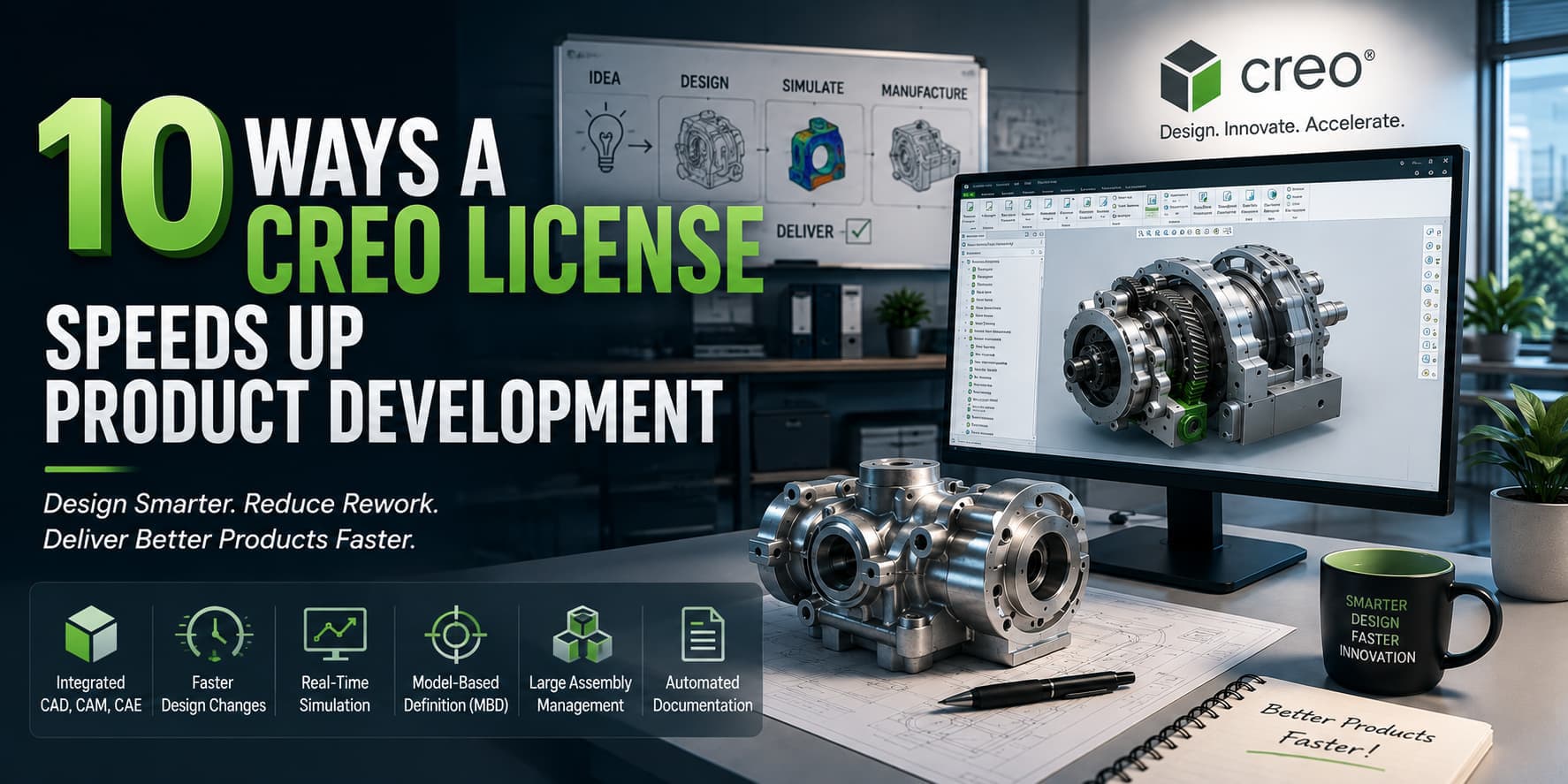
10 Ways a PTC Creo License Speeds Up Product Development
Design Smarter. Reduce Rework. Deliver Better Products Faster.
Every product starts with an idea. Turning that idea into a reliable, manufacturable product is where most engineering teams face challenges.
Design revisions. Communication gaps. Simulation delays. Multiple software tools. Manual documentation. Last-minute engineering changes.
These issues don’t just affect engineering—they increase development costs, delay product launches, and make collaboration difficult across teams.
That’s why companies are investing in a Creo license. More than just a CAD software, PTC Creo brings design, simulation, manufacturing, documentation, and product lifecycle management into one connected engineering environment.
According to PTC, organizations using an integrated product development approach can significantly reduce engineering rework while improving collaboration across product teams. Instead of moving files between multiple applications, engineers work from a single source of product data throughout development.
In this blog, we’ll explore 10 ways a Creo license helps accelerate product development, why choosing the right license matters, and how Sumedhas Tech Solutions, an Authorized PTC Partner, helps businesses get the most from their Creo investment.
Why Product Development Often Takes Longer Than Expected
Even experienced engineering teams encounter similar roadblocks.
- Design changes require multiple file updates.
- Large assemblies become difficult to manage.
- Simulation happens too late in the design process.
- Documentation consumes valuable engineering hours.
- Manufacturing teams work with outdated drawings.
- Different software tools create compatibility issues.
The result?
Longer design cycles, additional revisions, and increased engineering costs.
A Creo license addresses many of these challenges by connecting every stage of product development within a single platform.
Looking for the right Creo license?
Speak with our experts to identify the edition that fits your engineering requirements.
-
Integrated CAD, CAM, and CAE Reduce Engineering Silos
Many organizations still rely on separate software for design, simulation, and manufacturing.
Every file transfer increases the possibility of errors.
With Creo software, engineers can:
- Design components
- Validate performance
- Generate manufacturing toolpaths
- Create production documentation
—all within one environment.
This minimizes translation errors and keeps engineering teams working from the latest model.
Benefit
- Fewer software dependencies
- Reduced rework
- Better collaboration between departments
-
Parametric and Direct Modeling Speeds Up Design Changes
Engineering changes are unavoidable.
What matters is how quickly they can be implemented.
A Creo license combines parametric and direct modeling, allowing engineers to modify designs without rebuilding entire assemblies.
For example, if a customer requests a dimensional change, engineers can update the existing model instead of starting over.
Benefit
- Faster design iterations
- Improved engineering flexibility
- Reduced redesign effort
-
Real-Time Simulation Helps Identify Problems Earlier
Waiting until physical prototypes are built to discover design issues can be expensive.
Creo offers integrated simulation capabilities that allow engineers to evaluate:
- Structural performance
- Thermal behaviour
- Motion
- Fluid flow
before manufacturing begins.
Industry studies consistently show that identifying issues earlier in the design stage significantly reduces development costs compared to fixing them after production.
Benefit
- Fewer prototype iterations
- Better product quality
- Improved engineering confidence
Need simulation capabilities?
Our team can help you choose the right Creo Simulation license for your application.
-
Model-Based Definition (MBD) Improves Design Communication
Traditional 2D drawings often create confusion between engineering and production teams.
Model-Based Definition embeds:
- GD&T
- PMI
- Surface finish
- Manufacturing instructions
directly into the 3D model.
Everyone works from the same product definition.
Benefit
- Reduced drawing interpretation errors
- Better communication
- Faster manufacturing preparation
-
Large Assembly Management Improves Performance
Large assemblies can slow even powerful workstations.
Creo includes dedicated tools for managing complex products with thousands of components.
Engineers can:
- Load only required components
- Simplify assemblies
- Improve graphics performance
- Navigate models efficiently
This allows teams to continue designing without productivity losses.
-
Automated Documentation Saves Engineering Time
Engineering documentation often consumes hours that could be spent designing products.
With a Creo license, drawings, BOMs, exploded views, and manufacturing documentation are generated directly from the CAD model.
When the design changes, documentation updates automatically.
Benefit
- Less manual work
- Improved accuracy
- Faster release process
-
Additive Manufacturing Support Simplifies 3D Printing
Designing for additive manufacturing requires different engineering considerations.
Creo includes dedicated tools for:
- Lattice structures
- Build preparation
- Print validation
- Support generation
Engineers can prepare components for additive manufacturing without switching software.
This improves workflow while reducing preparation time.
-
Cloud Collaboration Keeps Teams Connected
Engineering projects rarely involve one department.
Design engineers, manufacturing teams, suppliers, and customers often need access to the latest product information.
Creo supports secure collaboration by allowing teams to:
- Share designs
- Review models
- Manage revisions
- Collect feedback
without unnecessary duplication of files.
Benefit
- Faster approvals
- Better collaboration
- Reduced communication gaps
-
Windchill Integration Creates a Connected Product Environment
Product data becomes difficult to manage when stored across different systems.
Creo integrates directly with PTC Windchill, allowing organizations to manage:
- CAD files
- BOMs
- Engineering changes
- Product documentation
- Version control
within a centralized PLM environment.
This improves traceability and reduces the risk of working with outdated information.
-
Scalable Licensing Supports Business Growth
Not every engineer requires the same capabilities.
PTC offers multiple Creo license options, including:
- Creo Design Essentials
- Creo Design Advanced
- Creo Design Professional
- Creo Design Engineering
- Specialized extensions for simulation, manufacturing, and analysis
Organizations can choose the license that matches their engineering requirements without paying for unnecessary functionality.
This makes Creo suitable for both growing engineering teams and large enterprises.
Common Challenges a Creo License Helps Solve
| Challenge | How Creo Helps |
|---|---|
| Design communication | Model-Based Definition |
| Frequent engineering changes | Parametric & Direct Modeling |
| Large assemblies | Advanced assembly management |
| Manual documentation | Automated drawing generation |
| Manufacturing errors | Associative manufacturing workflows |
| Multiple software tools | Unified CAD/CAM/CAE platform |
| Product data management | Windchill integration |
| Simulation delays | Integrated simulation |
Why Buy Your Creo License from Sumedhas Tech Solutions?
Purchasing software is only part of the process.
Choosing the right implementation partner determines how quickly your team starts seeing results.
As an Authorized PTC Partner, Sumedhas Tech Solutions provides:
Genuine PTC Creo Licenses
Choose from the complete portfolio of Creo software and extensions.
License Consultation
Not sure which edition suits your business?
Our experts evaluate your engineering workflow and recommend the right licensing option.
Creo Implementation
We help configure your environment for smooth deployment.
Training
Hands-on training helps engineering teams become productive faster.
Technical Support
Receive ongoing assistance for installation, licensing, upgrades, and troubleshooting.
PLM & Engineering Services
Beyond licensing, we also support:
- Windchill PLM Implementation
- PLM Customization
- CAD Services
- Data Migration
- Engineering Consulting
Unsure which Creo license is right for your business?
Book a free consultation with our specialists today.
Choosing the Right Creo License
Before purchasing, consider:
- How many engineers need access?
- Do you require simulation?
- Will you generate CNC toolpaths?
- Do you need additive manufacturing?
- Are you implementing Windchill?
- Will your engineering team grow over the next few years?
Answering these questions helps ensure you invest in the most suitable license.
A Creo license is more than a design tool. It supports engineering teams throughout product development—from concept and validation to manufacturing and product data management.
Whether you’re designing complex machinery, consumer products, automotive components, or industrial equipment, Creo helps reduce engineering effort, improve collaboration, and keep projects moving efficiently.
If you’re evaluating Creo software or comparing different Creo license options, selecting the right edition and implementation partner can make a measurable difference.
Ready to Choose the Right Creo License?
As an Authorized PTC Partner, Sumedhas Tech Solutions helps organizations select, deploy, and support the right Creo solution for their engineering needs.
Book a FREE Creo consultation today to:
- Compare Creo license editions
- Get expert licensing recommendations
- Schedule a live product demonstration
- Receive implementation and training guidance
Contact Sumedhas Tech Solutions today and find the Creo license that best fits your engineering requirements.


You must be logged in to post a comment.