
Factories That Think: How Agentic AI Is Redefining Manufacturing
The future of manufacturing is no longer about machines that simply follow instructions—it’s about intelligent systems that can analyze, adapt, and even collaborate. Smart factories are moving beyond automation into a new era of decision-making intelligence, driven by Agentic AI.
At Sumedhas Tech Solutions, we believe Agentic AI represents more than a technological shift—it’s a redefinition of manufacturing itself. By integrating intelligence into PLM, MES, and ERP, we help manufacturers move from automated processes to self-optimizing ecosystems that are resilient, sustainable, and future-ready.
This shift is transforming how manufacturers design, produce, and deliver products. By combining PLM (Product Lifecycle Management), MES (Manufacturing Execution Systems), and ERP (Enterprise Resource Planning) with Agentic AI, businesses are creating connected ecosystems that are faster, smarter, and more resilient.
The future of manufacturing isn’t just automated. It’s intelligent.
Let’s explore how this transformation unfolds.
The Role of PLM: Designing Smarter from the Start
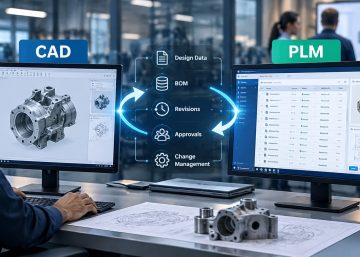
PLM is the foundation of product development, and AI is elevating its impact. With Agentic AI:
- Instant Validation: Bills of Materials (BOMs) can be checked in real time, reducing costly errors early in the process.
- Optimized Design Suggestions: AI algorithms analyze past projects and suggest design improvements, saving time while enhancing quality.
- Seamless Collaboration: Teams can access a shared data environment where AI ensures consistency, clarity, and traceability across every stage.
This means engineers no longer just design; they co-create with AI, building smarter products at greater speed.
The Role of MES: The Digital Brain of the Factory
While PLM guides design, MES governs production. With AI powering MES, the shop floor evolves into a responsive, intelligent environment:
- Predictive Maintenance prevents downtime by identifying equipment issues before they escalate.
- Dynamic Scheduling ensures resources are always optimized, adjusting in real time as conditions change.
- Process Intelligence provides visibility into every stage of production, making continuous improvement an ongoing reality.
Here, MES doesn’t just track production—it actively orchestrates it.
The Role of ERP: Balancing the Business Side
ERP has always been the backbone of operations. Now, with AI:
- Smart Forecasting predicts demand shifts with greater accuracy.
- Agile Procurement adjusts supply orders automatically based on real-time needs.
- Advanced Analytics turn operational data into actionable insights for decision-makers.
The result is an ERP system that goes beyond reporting—it becomes a true partner in balancing efficiency with profitability.
Data as the Fuel of Intelligence
All this progress relies on one critical factor: data. In modern factories, thousands of data points flow every second. But without intelligence, it’s just noise.
AI creates unified data layers that connect PLM, MES, and ERP into a single ecosystem. This enables:
- Faster insights from cross-functional data.
- Real-time decision-making at every level.
- Scalability that supports growth without bottlenecks.
When data is clean, connected, and contextualized, it becomes the fuel that drives transformation.
Multi-Agent Collaboration: Factories That Talk to Themselves
Agentic AI introduces a new paradigm—multi-agent collaboration. Here’s what it looks like:
- One AI agent detects a delay on the shop floor.
- Another automatically reschedules production tasks.
- A third adjusts procurement to avoid shortages.
This interaction happens instantly, without manual intervention. Factories become self-optimizing systems, minimizing disruptions and maintaining flow.
Quality and Compliance: AI as the Watchdog
Maintaining quality and meeting regulatory standards is one of the biggest challenges for manufacturers. AI tackles this head-on with:
- Automated Audits that run continuously, flagging issues in real time.
- Compliance Tracking across multiple regions without human intervention.
- CAPA Automation (Corrective and Preventive Actions) that ensures problems are solved and never repeated.
This means fewer recalls, fewer delays, and higher customer trust.
Benefits for Manufacturers
When factories shift from automation to intelligence, the results are measurable:
- Faster Time-to-Market – Products reach customers quicker.
- Reduced Costs – Predictive insights cut waste and downtime.
- Improved Quality – AI ensures consistent, high-standard production.
- Sustainability – Optimized operations minimize energy and material use.
- Empowered Workforce – Teams focus on innovation instead of repetitive tasks.
Challenges Ahead
Of course, transformation doesn’t come without obstacles. Manufacturers must overcome:
- Data Silos that block integration.
- Cybersecurity Risks that grow with connectivity.
- Scalability Issues as operations expand.
- Trust Gaps in relying on AI decisions.
- Cultural Resistance to new ways of working.
The organizations that succeed will be those that invest in both technology and change management.
The Road Ahead: Autonomous, Connected, and Human-Centric
What does the next phase of manufacturing look like? Imagine:
- Fully Autonomous Supply Chains that adjust instantly to global events.
- Closed-Loop Feedback Systems where every product generates insights for the next.
- End-to-End Digital Threads linking design, production, and delivery.
- Human-AI Partnerships where people focus on creativity while AI handles complexity.
The factories of tomorrow won’t just produce—they’ll learn, evolve, and self-optimize.
Ready to transform your engineering and product development processes?
At Sumedhas Tech Solution, we specialize in delivering PLM (Windchill) and CAD solutions that help organizations achieve seamless design collaboration, improved data management, and enhanced operational efficiency.
Get in touch with us today to discuss your business requirements or request a consultation.
Let’s build smarter, faster, and more connected product ecosystems — together.

You must be logged in to post a comment.