Imagine having a critical customer order ready to move into production, only to discover that a key component is unavailable. Your procurement team is waiting for supplier updates, engineers are checking whether an alternative component can be used, and production schedules are beginning to slip. Meanwhile, nobody has a complete picture of how this one shortage will affect the final product.
For businesses dealing with complex products, this situation is more than an operational inconvenience. It can lead to delayed deliveries, increased costs, missed commitments, and dissatisfied customers.
Supply chain disruptions rarely occur in isolation. A delay in component availability can affect engineering decisions, procurement schedules, production planning, and even product quality. When teams rely on disconnected systems and outdated product information, responding to these challenges becomes considerably harder.
This is where Product Lifecycle Management (PLM) makes a difference.
PLM brings product-related information, processes, and teams together through a connected digital environment. It gives businesses better visibility into product data, component dependencies, engineering changes, and supplier-related information, helping them make informed decisions when disruptions arise.
According to McKinsey’s 2024 Global Supply Chain Leader Survey, nine out of ten respondents experienced supply chain challenges during 2024. This highlights why businesses need stronger visibility and more structured approaches to managing supply chain risks.
So, how exactly can PLM help businesses minimise these risks?
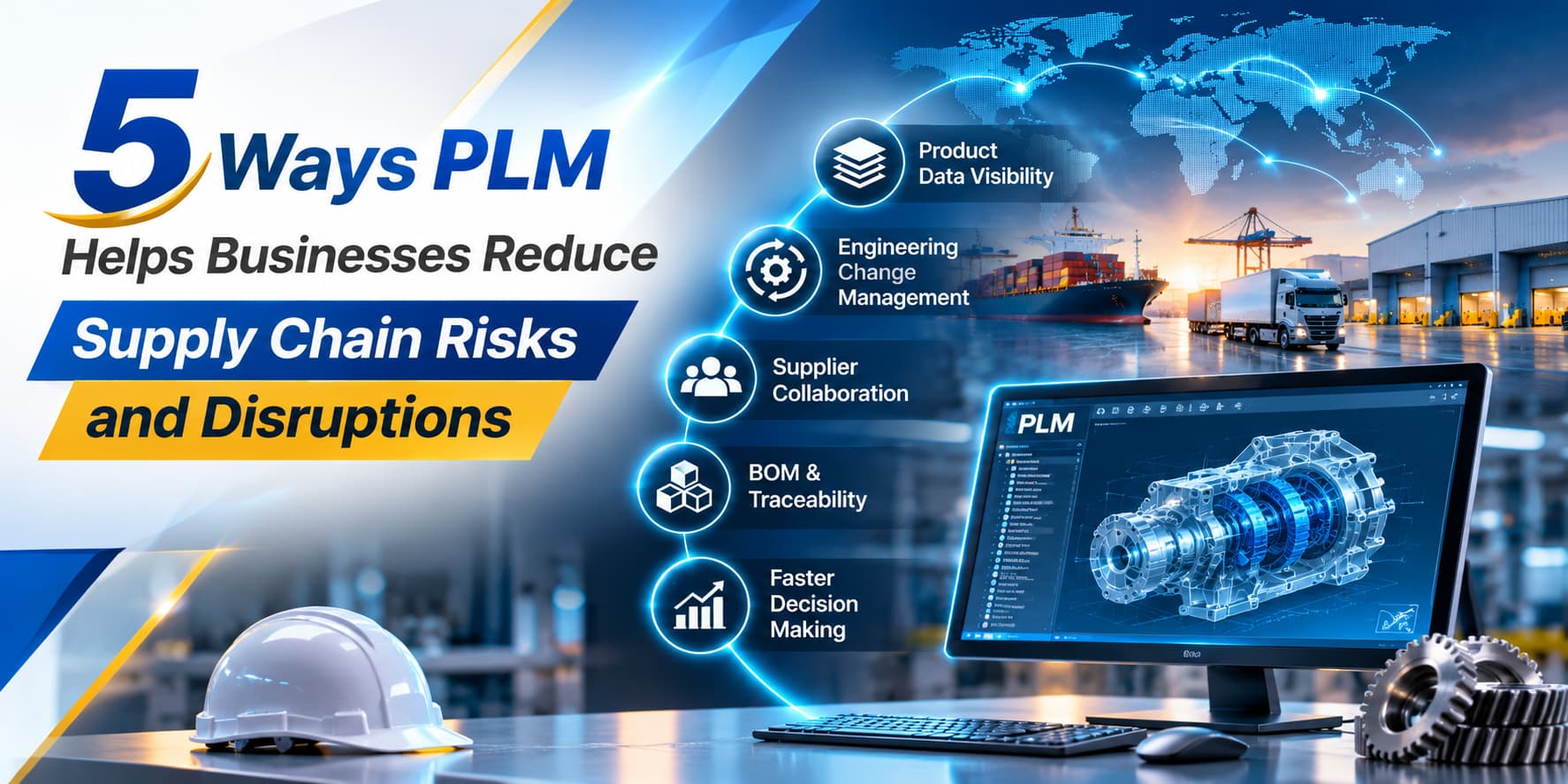
Let’s explore five important ways.
1. Improve Supply Chain Visibility with Centralised Product Data
One of the biggest challenges businesses face during supply chain disruptions is the lack of reliable, accessible information.
Product specifications may be stored in one system, engineering drawings in another, and supplier information in spreadsheets or separate applications. When teams cannot access the same information, even a simple procurement decision can involve multiple rounds of communication and verification.
For instance, imagine a component supplier suddenly informing your procurement team that a particular part will no longer be available. The team needs to determine which products use that component, whether an approved alternative exists, and which upcoming orders could be affected.
Without connected product information, finding these answers can take valuable time.
PLM helps address this challenge by creating a centralised source of product-related information. Engineering teams, procurement professionals, and other authorised stakeholders can access relevant product specifications, bills of materials (BOMs), revision histories, and engineering documentation.
How Does Centralised Product Data Reduce Supply Chain Risks?
- Better component traceability: Identify where specific components are used across different products and assemblies.
- Faster information access: Reduce dependence on scattered spreadsheets, emails, and manually maintained documents.
- Improved coordination: Give engineering, procurement, and production teams access to consistent product information.
- More informed decisions: Understand the potential impact of component shortages or supplier changes before taking action.
With a connected view of product information, businesses can spend less time searching for answers and more time addressing the actual disruption.
Want to improve visibility across your product data? Explore PLM solutions with Sumedhas Tech Solutions.
2. Manage Engineering Changes Without Creating Supply Chain Confusion
Product changes are a normal part of product development. A design may need modification because of component unavailability, performance requirements, compliance updates, or supplier-related constraints.
However, managing these changes across multiple departments can become complicated when information is not synchronised.
Consider a situation where an engineering team replaces a particular electronic component because the existing supplier can no longer meet delivery requirements. The change may seem straightforward from an engineering perspective, but it has several downstream implications.
Procurement needs to source the replacement component. Production needs updated assembly information. Quality teams need to verify the revised specifications, and other stakeholders must know which product revision is currently approved.
If these updates are communicated through disconnected channels, teams may continue working with outdated information.
This can result in:
- Procurement orders being placed for obsolete components.
- Production teams using incorrect engineering drawings.
- Rework caused by outdated product specifications.
- Delays in validating and approving alternative components.
- Confusion over which product revision is authorised for use.
PLM helps businesses manage engineering changes through structured workflows, revision control, and change management processes.
Engineering Change Requests (ECRs) and Engineering Change Orders (ECOs) help organisations document proposed modifications, review their implications, obtain approvals, and communicate authorised changes to relevant stakeholders.
Why Is Engineering Change Management Important During Supply Chain Disruptions?
When a supplier issue requires a component substitution or design modification, businesses need to understand the consequences before implementing the change.
A structured PLM environment helps teams evaluate the impact on product configurations, associated components, documentation, and downstream processes.
This means changes can be managed with better control, reducing the possibility of conflicting information and unnecessary delays.
Managing frequent engineering changes? Speak with Sumedhas Tech Solutions about implementing a structured PLM change management process.
3. Strengthen Supplier Collaboration and Component Traceability
A supply chain is only as dependable as the information shared between the businesses and partners involved in it.
When suppliers, engineering teams, and procurement departments operate with different versions of product specifications, communication gaps can create avoidable risks.
For example, a supplier may manufacture or deliver a component based on an outdated drawing. Your internal team may have already approved a revised specification, but the updated information has not reached the supplier through the appropriate process.
The result? Incorrect components, quality concerns, additional verification, and possible delivery delays.
PLM can help establish a more structured approach to supplier collaboration by making relevant product information available to authorised stakeholders.
Depending on the PLM solution and its integrations, businesses can manage and share:
- Approved product specifications and engineering drawings.
- Component and BOM information.
- Revision histories and change notifications.
- Supplier-related documentation.
- Quality requirements and supporting records.
- Product-related approvals and workflows.
This creates a more consistent information flow between internal teams and external partners.
How Does PLM Improve Supplier-Related Risk Management?
1. Better Information Consistency
Suppliers and internal teams can work with approved product documentation, reducing the possibility of errors caused by outdated specifications.
2. Improved Component Traceability
Businesses can understand where components are used and identify products or assemblies that may be affected by a supplier issue.
3. More Structured Communication
Documented workflows and controlled information sharing help reduce dependency on informal email exchanges.
4. Faster Evaluation of Alternatives
When a component becomes unavailable, teams can review product dependencies and assess possible alternatives using reliable product information.
It is important to note that PLM does not independently guarantee supplier performance or prevent external disruptions. However, it gives businesses a stronger information foundation to assess supplier-related risks and coordinate their response.
Looking to improve supplier coordination and product traceability? Discover how Sumedhas can help you implement PTC PLM solutions.
4. Reduce the Impact of Component Shortages with Better BOM Management
A Bill of Materials (BOM) is more than a list of components required to build a product. It provides an important view of how individual parts, subassemblies, and materials come together to form the final product.
When a critical component becomes unavailable, businesses need to understand exactly where that component is used and which products, assemblies, or orders could be affected.
Without accurate BOM information, this assessment can become a time-consuming exercise.
For instance, imagine an electronics company using the same electronic component across several product variants. A supplier suddenly announces a shortage of that component.
The procurement team needs to identify the affected products. Engineering needs to assess whether an alternative component is technically suitable. Production needs to understand which schedules may be affected, while quality teams must review any required validation.
An accurate, connected BOM makes this assessment easier.
PLM solutions help businesses create, manage, and maintain product structures while connecting component information with associated engineering documentation and revisions.
Key Benefits of Effective BOM Management Through PLM
- Component-level visibility: Identify the products and assemblies associated with a particular component.
- Better impact assessment: Understand which product structures may be affected by component shortages.
- Improved revision management: Maintain visibility into changes made to product structures.
- Alternative component evaluation: Support engineering and procurement teams in assessing suitable replacement options.
- More informed procurement decisions: Help teams work with accurate product requirements and approved component information.
For businesses managing complex products with multiple variants, an accurate BOM can make a significant difference in how quickly they understand and respond to component-related disruptions.
The real value lies in connecting BOM information with the wider product lifecycle, rather than treating it as an isolated document.
Still managing complex BOM structures manually? Connect with Sumedhas Tech Solutions to explore how PTC PLM can simplify BOM management.
5. Make Better Decisions with Connected Product Information and Digital Workflows
When a supply chain disruption occurs, the speed and quality of decision-making matter.
However, businesses cannot make informed decisions if the information required to assess a situation is scattered across departments, applications, and documentation.
For example, when a supplier announces an unexpected delivery delay, the procurement team may know which component is affected. But does the engineering team know whether an alternative part is approved? Can production identify the affected product variants? Can management understand the potential impact on ongoing commitments?
These questions require information from multiple functions.
PLM helps connect product information and related workflows, enabling authorised teams to access relevant data and collaborate more effectively.
With the right implementation, businesses can establish digital workflows for engineering approvals, product changes, documentation reviews, and other product-related processes.
How Connected PLM Workflows Support Better Decisions
Centralised Product Information
Teams can refer to a common product information environment instead of depending on disconnected documents.
Structured Approval Processes
Engineering changes and product-related decisions can follow defined review and approval workflows.
Improved Cross-Functional Collaboration
Engineering, procurement, quality, and other teams can coordinate using consistent information.
Better Product Lifecycle Traceability
Businesses can maintain a record of product revisions, changes, and associated documentation.
A Stronger Foundation for Digital Transformation
Connected PLM data can support broader digital initiatives through integrations with ERP, MES, and other enterprise systems, depending on the organisation’s architecture.
This is particularly valuable for businesses that want to move away from reactive, manual processes and establish a more structured approach to managing product-related risks.
By connecting product information with business workflows, PLM helps decision-makers understand the implications of disruptions and coordinate appropriate responses.
Ready to connect your product data and business processes? Book a PLM consultation with Sumedhas Tech Solutions.
Why Should Businesses Invest in PLM for Supply Chain Risk Management?
Supply chain resilience is not achieved simply by finding alternative suppliers or maintaining additional inventory. Businesses also need to understand their products, components, dependencies, and the impact of changes across their operations.
This is where PLM offers considerable value.
A well-implemented PLM solution helps businesses address several operational challenges:
- Disconnected product information: Centralised product data makes it easier for engineering, procurement, and production teams to access consistent information.
- Uncontrolled engineering changes: Structured change management and revision control help prevent teams from working with outdated product specifications.
- Supplier communication gaps: Controlled information sharing supports better coordination between internal teams and external partners.
- Component shortages: Improved BOM visibility and component traceability help businesses identify potentially affected products and assemblies.
- Slow decision-making: Connected product information helps teams assess disruptions and make informed decisions.
- Product documentation errors: Controlled documentation helps maintain consistency across product-related processes.
- Limited product lifecycle visibility: Better traceability helps businesses understand product changes and dependencies.
The benefits extend beyond responding to individual disruptions. A well-implemented PLM environment can help businesses improve engineering collaboration, manage product complexity, support compliance requirements, and establish more consistent processes.
The key is to implement a solution that aligns with the organisation’s product development processes, technology landscape, and operational requirements.
How Sumedhas Tech Solutions Helps Businesses Strengthen Their PLM Capabilities
Choosing the right PLM platform is only one part of building a connected product data environment. Businesses also need the right implementation approach, technical expertise, and ongoing support to ensure that the solution addresses their actual operational challenges.
At Sumedhas Tech Solutions, we help businesses take a structured approach to Product Lifecycle Management through our PTC PLM solutions and services.
As an authorised PTC PLM licence provider, Sumedhas helps organisations access PTC’s PLM technology while supporting them with services that align with their business and technical requirements.
Whether your organisation is exploring PLM for the first time or looking to improve an existing PLM environment, our team can help you evaluate the right approach.
What Can Sumedhas Tech Solutions Help You With?
1. PTC PLM Licensing
Access PTC PLM solutions through an authorised licensing provider and explore the capabilities that align with your business requirements.
2. PLM Implementation Services
Get support in planning and implementing PLM solutions based on your product data, engineering processes, and organisational needs.
3. PLM Customisation and Configuration
Align PLM capabilities and workflows with your existing business processes and technical requirements.
4. PLM Integration Services
Connect relevant product information and workflows with other enterprise applications, subject to your integration requirements.
5. PLM Support and Consulting
Get guidance on improving your PLM environment, addressing implementation challenges, and identifying opportunities to strengthen product data management.
Our approach focuses on helping businesses make practical use of PLM technology, rather than simply introducing another software platform into their existing IT environment.
Not sure which PTC PLM solution is right for your organisation? Talk to the Sumedhas Tech Solutions team for expert guidance.
Take Control of Supply Chain Risks with the Right PLM Strategy
Supply chain disruptions may be triggered by external factors, but the way businesses respond to them often depends on the quality of their internal processes and information systems.
Disconnected product data, uncontrolled engineering changes, limited component traceability, and communication gaps can make an already difficult situation more complicated.
Product Lifecycle Management helps address these challenges by connecting product information, supporting structured workflows, and improving collaboration across teams.
From managing BOM changes to evaluating alternative components and maintaining accurate engineering documentation, PLM gives businesses a stronger foundation for making informed decisions.
However, achieving these benefits requires more than selecting a software licence. It requires the right solution, implementation strategy, and technical support.
Sumedhas Tech Solutions can help you take that step.
As an authorised PTC PLM licence provider offering PLM-related services, we work with businesses to identify suitable solutions and build a PLM environment that supports their product development and business objectives.
Ready to improve product visibility, manage engineering changes, and strengthen your supply chain processes?
Get in touch with Sumedhas Tech Solutions today to schedule a free PLM consultation or product demo.
Let’s discuss your business requirements and explore how PTC PLM can help you build a more connected, informed, and resilient operation.



You must be logged in to post a comment.