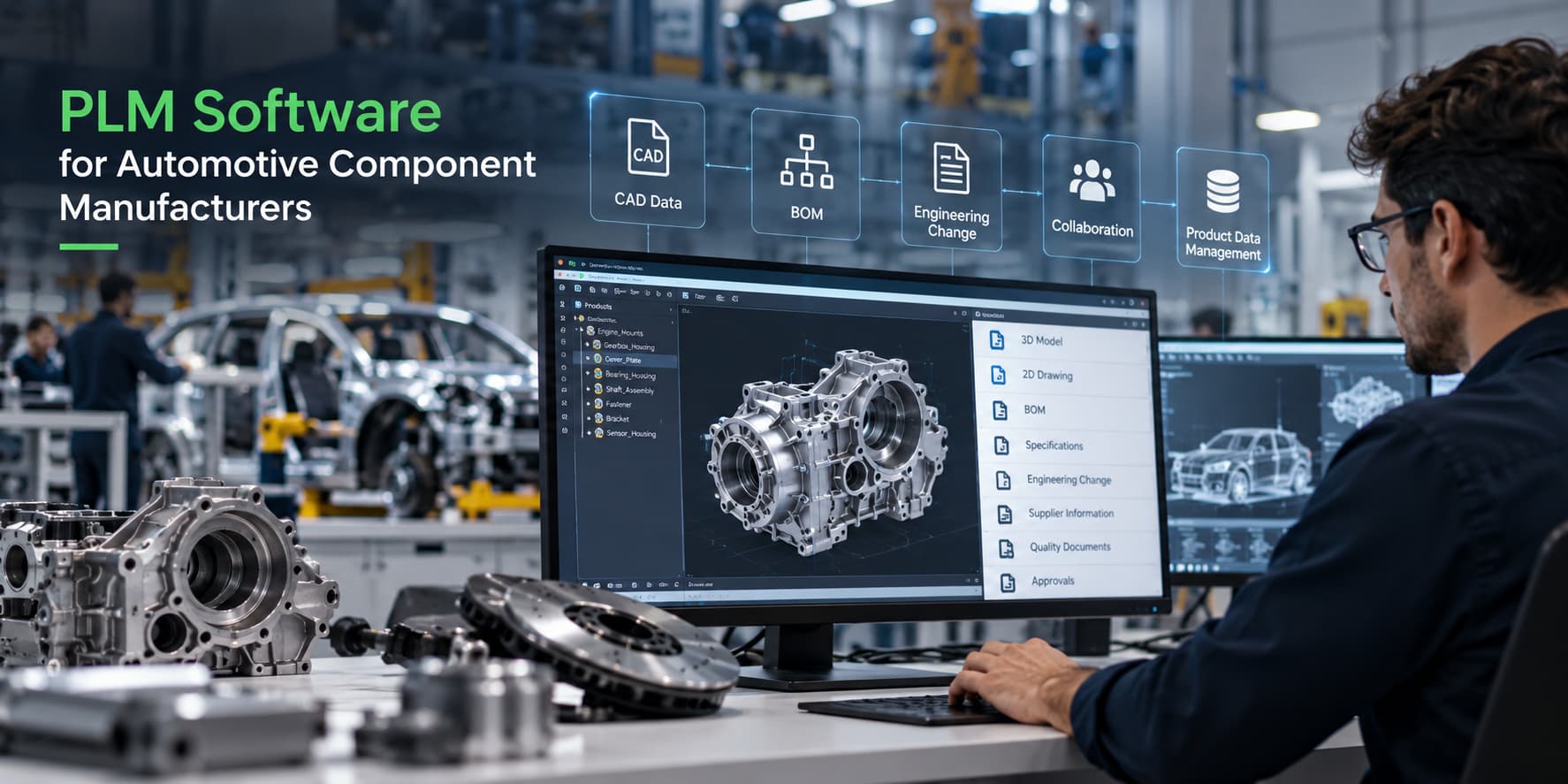
How PLM Software Helps Automotive Component Manufacturers Manage Product Data
For an automotive component manufacturer, product data is rarely limited to a CAD model or an engineering drawing. A single component can be associated with multiple CAD files, drawings, revisions, engineering BOMs, specifications, supplier information, quality documents, approvals, and engineering change records. As product complexity and the number of programs increase, managing this information through shared folders, spreadsheets, email attachments, and disconnected applications can become difficult to control.
This is where Product Lifecycle Management (PLM) software becomes important. PLM provides a structured environment for managing product information, product structures, revisions, engineering changes, workflows, and collaboration throughout the product lifecycle. For automotive component manufacturers, it provides a common framework that connects engineering data with the processes that create, review, approve, change, and release that data.
PTC Windchill, for example, provides capabilities for product data management, BOM management, change management, CAD data management, configuration management, and collaboration.
Sumedhas Tech Solutions is an authorized PTC PLM license provider and provides PLM consulting, implementation, integration, migration, customization, application support, and related services.
Looking to improve product data management across your automotive engineering teams? Talk to a Sumedhas PLM specialist.
What Is PLM Software for Automotive Component Manufacturers?
PLM software provides a centralized and controlled environment for managing product information and the processes associated with it. In an automotive component organization, this can include CAD models, engineering drawings, parts, assemblies, BOMs, specifications, documents, revisions, engineering changes, approvals, and supplier-related product information.
The important distinction is that PLM is not simply another document-storage system. It establishes relationships between product information. A CAD model can be associated with a part, the part can belong to an assembly, the assembly can be represented in a BOM, and the entire structure can be governed by revision and lifecycle processes.
For example, when an engineer modifies a component, the organization may need to determine which assembly uses that component, whether the BOM needs to change, whether an associated drawing requires revision, whether a supplier needs updated information, and whether the change requires formal approval. A PLM system can provide the structure required to manage these relationships rather than treating every file as an independent item.
Why Is Product Data Management Important for Automotive Component Manufacturers?
Automotive component development involves large amounts of engineering information and frequent changes. Components may go through multiple design iterations before release, while different teams may work simultaneously on CAD models, drawings, BOMs, specifications, testing information, and supplier documentation.
When this information is managed independently, teams can lose visibility into the relationship between a design and the product information surrounding it. A revised CAD model may exist without a corresponding BOM update, or a supplier may continue working from an older drawing because the latest revision was not communicated through a controlled process.
PLM addresses this by creating a controlled product-data environment. Instead of asking engineers to manually determine which files are related to a component, organizations can establish relationships between CAD data, parts, documents, product structures, revisions, and changes.
For automotive component manufacturers, this becomes increasingly relevant as product portfolios, engineering teams, suppliers, and customer requirements grow.
What Problems Does PLM Solve for Automotive Component Manufacturers?
The value of PLM becomes clearer when it is connected to specific engineering and product-data problems.
Managing Multiple CAD Revisions
A component can go through several iterations before it is released. If these revisions are stored across different folders or exchanged through email, engineers may have difficulty identifying the current version.
PLM provides revision and lifecycle controls so that teams can distinguish between working, under-review, approved, released, and obsolete product information. This creates a clearer relationship between the CAD data and its status within the product development process.
Connecting CAD Data With Product Structures
A CAD assembly represents the design structure, while a product structure or BOM represents how the organization defines the product. Keeping these structures aligned manually can create unnecessary effort and discrepancies.
PLM can maintain relationships between CAD documents, parts, assemblies, and product structures. In Windchill, for example, CAD documents can be associated with parts and product structures, allowing engineering information and product information to remain connected.
Controlling Engineering Changes
An engineering change rarely affects only one file. Changing a component may also affect an assembly, drawing, BOM, specification, supplier, or related product.
A PLM system can provide an engineering change process in which the change is requested, reviewed, assessed for impact, approved, implemented, and released. This provides greater traceability than managing changes through email conversations and manually updated spreadsheets.
Reducing Duplicate Parts and Designs
Automotive engineering organizations can accumulate large numbers of components over time. Without effective classification and search capabilities, engineers may not realize that an existing component already meets their requirements.
PLM can support classification, search, and reuse of existing product information. This can help engineering teams identify similar components before creating new ones.
Improving Supplier Collaboration
Automotive component manufacturers frequently exchange engineering information with suppliers. Sharing files manually can create uncertainty around revisions and approvals.
PLM can provide controlled mechanisms for sharing relevant product information with external parties while maintaining appropriate access and lifecycle controls.
These examples illustrate that PLM is primarily about controlling relationships between product information and the processes that govern it, rather than simply storing more files.
How Does PLM Manage CAD Data and Engineering Drawings?
CAD data is one of the most important categories of information managed within an automotive engineering environment. However, CAD files rarely exist independently. A model may be associated with drawings, parts, assemblies, specifications, and BOM information.
A PLM system can provide versioning, revision management, access control, lifecycle states, and relationships between CAD documents and product structures. Engineers can work with product data through the appropriate CAD-PLM integration rather than manually moving files between local folders and shared repositories.
For organizations using Creo, Windchill provides integration between the CAD environment and PLM processes, allowing engineering teams to manage CAD data within a controlled product-data environment. Multi-CAD capabilities can also be relevant for organizations working with more than one CAD platform.
The practical benefit is that CAD data becomes part of the broader product definition instead of remaining isolated within the engineering department.
How Does PLM Help Automotive Suppliers Manage Product Revisions?
Automotive suppliers may manage product information across multiple customer programs, product variants, engineering revisions, and supplier relationships. Keeping track of which revision applies to which program can become challenging when information is maintained manually.
PLM can provide lifecycle and configuration management capabilities that help organizations distinguish between revisions and product configurations. This is particularly useful when a component has variations based on customer, vehicle program, region, specification, or production requirement.
Instead of treating every drawing or CAD file as an isolated document, the organization can maintain the context in which that product information is valid.
This can improve product-data control while also giving engineering teams a clearer understanding of which information belongs to which product configuration.
How Does PLM Support Design Reuse in Automotive Engineering?
Design reuse can reduce unnecessary engineering work, but effective reuse depends on whether engineers can find existing components quickly and determine whether they are suitable for the new requirement.
A PLM system can support this through classification, metadata, search, and structured product information. Engineers can search for existing components based on defined attributes rather than relying solely on file names or folder locations.
For example, before creating a new bracket, an engineer could search the existing product database for brackets with similar dimensions, materials, application areas, or functional characteristics.
This does not mean every existing component should automatically be reused. Engineering teams still need to evaluate suitability. However, better product-data visibility gives them the information needed to make that decision.
How Does PLM Improve Product Traceability?
Traceability means being able to establish the relationship between product information, changes, approvals, and lifecycle events.
For an automotive component manufacturer, this could mean answering questions such as:
- Which CAD revision was released?
- Which part number is associated with the design?
- Which BOM contains the component?
- When was the design changed?
- Who approved the change?
- Which documents were affected?
- Which supplier received the revised information?
- Which product configuration uses the component?
PLM can maintain these relationships within a controlled environment.
This becomes particularly valuable when organizations need to investigate a product change, respond to customer queries, review historical information, or understand the impact of a design modification.
What Are the Key Benefits of PLM for Automotive Component Manufacturers?
The benefits of PLM are closely connected to the problems it solves. By bringing product information and engineering processes into a controlled environment, organizations can improve several areas of product development.
Better Control Over Product Data
Teams can manage CAD files, drawings, parts, BOMs, specifications, and related documents using defined lifecycle and revision processes.
Improved Engineering Collaboration
Engineering, manufacturing, quality, procurement, and supplier-facing teams can work from relevant and controlled product information instead of relying on repeated file exchanges.
More Consistent Product Structures
Connecting CAD information with product structures can reduce the effort involved in manually reconciling engineering data with BOM information.
Better Change Visibility
Engineering teams can identify the information affected by a change and maintain a record of the approval and release process.
Improved Design Reuse
Classification and search capabilities can help engineers identify existing components and reduce unnecessary duplication.
Stronger Product Traceability
Relationships between parts, CAD data, revisions, documents, and changes can provide a more complete product history.
Better Supplier Collaboration
Controlled access to product information can provide suppliers with the relevant information while maintaining product-data governance.
Want to identify which of these PLM benefits are most relevant to your organization? Request a PLM consultation with Sumedhas Tech Solutions.
How Can PLM Connect Engineering With Other Business Systems?
PLM does not necessarily operate in isolation. Automotive component manufacturers may need to connect product information with ERP, MES, quality systems, supplier platforms, document-management systems, or other enterprise applications.
For example, PLM may manage engineering product structures while ERP manages purchasing and production-related transactions. Integration between these systems can help establish a controlled flow of information between engineering and downstream business processes.
The integration architecture depends on the organization’s systems, data ownership, business processes, and security requirements.
This is one reason PLM implementation should begin with a process and system assessment rather than simply installing software.
What Challenges Should Automotive Component Manufacturers Expect During PLM Implementation?
PLM can address product-data problems, but implementation itself requires careful planning.
Legacy Data Migration
Automotive companies may have years of CAD files, drawings, BOMs, and documents. Migrating all of this information without classification or data cleansing can transfer existing problems into the new environment.
Data Standardization
Different departments may use different naming conventions, numbering systems, metadata, and revision practices. These differences need to be addressed before establishing a common product-data structure.
Complex Product Relationships
Components can be used in multiple assemblies, programs, and configurations. PLM configuration needs to reflect these relationships accurately.
User Adoption
Engineers who have relied on shared drives or informal processes may need time and training to adapt to controlled PLM workflows.
Integration With Existing Applications
Connecting PLM with CAD, ERP, MES, quality, and other applications requires clear decisions about which system owns which data and how information should move between systems.
Customization
Every organization has different workflows and requirements. Excessive customization, however, can make future upgrades and maintenance more difficult. A good implementation should distinguish between processes that genuinely require configuration and processes that can follow standard PLM capabilities.
Why Choose Sumedhas Tech Solutions for Automotive PLM?
Selecting the PLM platform is only one part of the decision. The implementation and consulting partner also plays an important role in translating business requirements into an effective product-data environment.
Sumedhas Tech Solutions is an authorized PTC PLM license provider and provides PLM consulting, implementation, integration, migration, customization, application support, training, and related services. The company states that it has worked with more than 200 clients across industries including automotive, aerospace, high-tech, and other engineering sectors.
For automotive component manufacturers, this combination of licensing and services can support different stages of the PLM journey, whether the requirement is a new implementation, migration from an existing system, CAD-PLM integration, customization, or ongoing application support.
Planning a Windchill implementation or evaluating PTC PLM licensing? Contact Sumedhas Tech Solutions to discuss your requirements.
What PLM Services Does Sumedhas Tech Solutions Provide?
Sumedhas Tech Solutions supports organizations across several areas of PLM implementation and product-data management.
PLM Consulting and Process Assessment
The engagement can begin with understanding the organization’s existing product-data processes, identifying gaps, and defining a PLM approach aligned with business requirements.
Windchill PLM Implementation
Implementation can include configuration of product structures, lifecycle states, workflows, user roles, access controls, and other PLM capabilities required by the organization.
CAD-PLM Integration
CAD systems can be connected with PLM so that engineering models, drawings, parts, assemblies, and product structures can be managed within an integrated environment.
PLM Migration and Upgrade
Organizations with existing PLM environments may require migration, upgrades, data transformation, or restructuring of product information.
PLM Customization and Integration
Where standard capabilities do not fully address a business requirement, appropriate customization or integration can be considered.
Application Support and Training
Post-implementation support and user training can help organizations maintain the system and improve adoption over time.
Sumedhas Tech Solutions lists PLM strategy and process consulting, implementation, upgrade and migration, application support, and training among its services.
Discuss your automotive PLM requirements with the Sumedhas Tech Solutions team.
When Should an Automotive Component Manufacturer Consider PLM?
PLM becomes particularly relevant when product-data complexity begins creating operational problems.
If engineers regularly spend time searching for CAD files, if multiple revisions exist across departments, if BOMs require frequent manual reconciliation, or if engineering changes are difficult to trace, these are signs that the organization may benefit from a structured product-data management approach.
The same applies when an organization is expanding its product portfolio, working with more suppliers, managing multiple customer programs, or connecting engineering with ERP and other enterprise systems.
Rather than waiting until product-data problems become difficult to control, organizations can conduct a PLM assessment to identify where structured product-data management could provide the greatest benefit.
How Can PLM Improve the Product Data Lifecycle?
The real value of PLM is visible when product information is managed consistently from creation through revision, approval, release, and subsequent change.
A simplified lifecycle might look like:
Create → Review → Approve → Release → Change → Re-approve → Release
At each stage, the organization can define who is responsible, what information is required, what approvals are needed, and which version is considered valid.
For an automotive component manufacturer, this creates a controlled product-data history rather than a collection of disconnected files.
Build Better Control Over Automotive Product Data
For automotive component manufacturers, managing product data effectively is essential because every component is connected to a wider network of designs, parts, assemblies, BOMs, documents, suppliers, revisions, and engineering decisions.
When this information is distributed across disconnected systems, organizations can face revision confusion, duplicate components, BOM inconsistencies, difficult engineering changes, and limited visibility into product history.
PLM provides a structured way to connect this information and the processes that control it.
By integrating CAD data with product structures, revisions, BOMs, engineering changes, approvals, and collaboration processes, automotive component manufacturers can create a more controlled and traceable product-data environment.
The implementation approach should always reflect the organization’s existing CAD environment, product complexity, data quality, engineering workflows, integrations, and user requirements.
Sumedhas Tech Solutions can support this journey through PTC PLM licensing, PLM consulting, Windchill implementation, CAD-PLM integration, migration, customization, training, and ongoing application support.
Looking to Improve Automotive Product Data Management?
If your organization is dealing with CAD revision problems, disconnected BOMs, duplicate components, difficult engineering changes, scattered product information, or supplier-data challenges, a PLM assessment can help identify where improvements can be made.
Book a free PLM consultation or request a Windchill demo from Sumedhas Tech Solutions to discuss your automotive product-data requirements.
Need PTC PLM licensing? Contact Sumedhas Tech Solutions to discuss the right licensing and implementation approach for your organization.
Frequently Asked Questions About PLM for Automotive Component Manufacturers
What Is PLM Software Used for in Automotive Component Manufacturing?
PLM software is used to manage product information such as CAD files, drawings, parts, BOMs, specifications, revisions, engineering changes, approvals, and related documentation. It also provides workflows and relationships that help organizations control how this information is created and changed.
How Does PLM Help Manage Automotive CAD Data?
PLM can provide version control, revision management, lifecycle management, access control, search, and relationships between CAD documents and product structures. With appropriate CAD integration, engineers can manage design data within the broader product-data environment.
Can PLM Manage Automotive BOMs?
Yes. PLM platforms can manage product structures and BOM information, including relationships between parts, assemblies, revisions, and configurations.
How Does PLM Help With Engineering Changes?
PLM provides structured change processes that can connect change requests with affected product information, reviews, approvals, implementation, and release.
Can PLM Reduce Duplicate Parts?
A properly structured PLM environment can improve classification and search, making it easier for engineers to identify existing components before creating new ones. It does not automatically eliminate duplicate parts, but it can provide the information and processes needed to reduce unnecessary duplication.
Can PLM Support Supplier Collaboration?
Yes. PLM platforms can provide controlled mechanisms for sharing relevant product information with suppliers and other external partners, depending on the organization’s configuration and security requirements.
Does Sumedhas Tech Solutions Provide PTC PLM Licensing?
Yes. Sumedhas Tech Solutions identifies itself as an authorized PTC PLM license provider and also provides PLM implementation, integration, migration, customization, training, and support services.
Can Sumedhas Tech Solutions Help With Windchill Implementation?
Yes. Sumedhas Tech Solutions provides PLM implementation and related services, including Windchill-focused consulting, integration, migration, customization, and application support.


You must be logged in to post a comment.