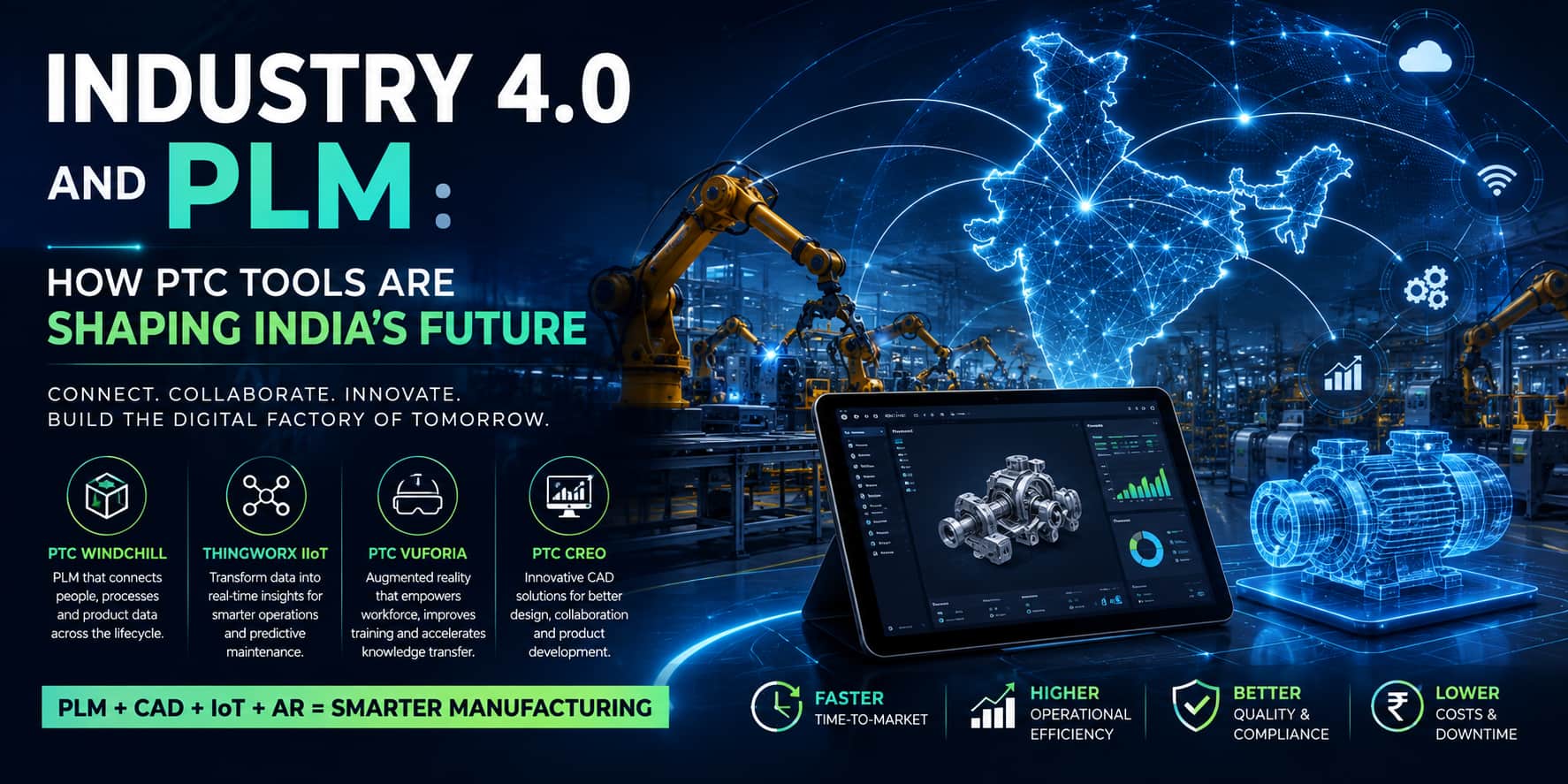
Industry 4.0 and PLM: How PTC Tools Are Transforming Indian Manufacturing
Industry 4.0 is changing the way manufacturers design, develop, produce, service, and manage products. For Indian manufacturing companies, this transformation is no longer simply about adopting connected machines or automating individual processes. It is about creating a connected digital ecosystem in which engineering data, product information, manufacturing processes, service data, and operational intelligence work together.
At the center of this transformation is Product Lifecycle Management (PLM).
Modern PLM solutions help organizations manage product information and processes throughout the complete product lifecycle—from initial concept and engineering design to manufacturing, service, maintenance, and end-of-life.
PTC technologies such as PTC Windchill, PTC Creo, ThingWorx, and PTC Vuforia can play important roles in this connected manufacturing ecosystem. When these technologies are implemented as part of a broader digital engineering strategy, manufacturers can establish a stronger Digital Thread, improve collaboration, reduce information silos, and make better data-driven decisions.
For Indian manufacturers competing in increasingly global markets, this connected approach can provide a foundation for improving product development, manufacturing efficiency, quality, and operational agility.
Is your engineering and manufacturing data disconnected?
Explore PLM solutions, implementation, integration, and consulting services with Sumedhas Tech Solutions.
What Is Industry 4.0 and Why Does PLM Matter?
Industry 4.0 represents the evolution of manufacturing through technologies such as:
- Industrial IoT (IIoT)
- Cloud computing
- Artificial intelligence and analytics
- Digital twins
- Connected products
- Automation
- Augmented reality
- Advanced manufacturing systems
- Product Lifecycle Management
However, simply deploying these technologies does not automatically create a connected digital enterprise.
Manufacturers also need a reliable way to manage the product data and processes that connect engineering, manufacturing, service, and other business functions.
This is where PLM becomes strategically important.
A modern PLM platform provides a structured environment for managing product information, engineering processes, documents, configurations, revisions, changes, and collaboration throughout the product lifecycle.
Instead of different departments working with disconnected information, PLM can establish a common source of product-related information.
This creates the foundation for a Digital Thread.
Building the Digital Thread from Engineering to Manufacturing
One of the most important concepts associated with Industry 4.0 is the Digital Thread.
A Digital Thread connects information and processes across different stages of the product lifecycle. It helps organizations maintain continuity of product information as a product moves from concept and design through manufacturing, service, and other lifecycle stages.
Consider a typical engineering organization.
A design engineer creates a product using CAD software. Engineering teams then review the design, manage revisions, create product structures, release information, and communicate changes to manufacturing.
Without an integrated digital environment, information can become fragmented across spreadsheets, emails, shared folders, disconnected applications, and manually maintained documents.
This creates risks such as:
- Duplicate product information
- Outdated drawings
- Manual data entry
- Poor change visibility
- Communication gaps
- Manufacturing errors
- Longer product development cycles
A connected PLM environment helps address these challenges by providing controlled product information and structured lifecycle processes.
PTC Windchill is particularly relevant to this environment because it provides capabilities for managing product data, product structures, engineering changes, configurations, documents, collaboration, and lifecycle processes.
When PLM is connected with CAD and downstream manufacturing systems, organizations can establish greater digital continuity between as-designed, as-planned, and as-built product information.
PTC Windchill and Product Lifecycle Management
PTC Windchill is a PLM platform designed to help organizations manage product information and processes across the product lifecycle.
For engineering and manufacturing organizations, Windchill can support areas such as:
- Product data management
- CAD data management
- Document management
- Product structures
- Bill of Materials (BOM) management
- Engineering change management
- Configuration management
- Product collaboration
- Lifecycle and workflow management
- Manufacturing process management
The value of PLM becomes particularly significant when multiple engineering teams, manufacturing locations, suppliers, and business functions need to work with consistent product information.
For example, when an engineering change is approved, the organization needs to understand:
What changed?
Which product or component is affected?
Which documents and CAD models are affected?
Which manufacturing processes need to be updated?
Which teams need to be informed?
Which version is approved for production?
A structured PLM environment can help organizations manage these relationships more effectively.
For Indian OEMs and engineering-driven manufacturers, this type of product data control can become increasingly important as product complexity and supply-chain collaboration increase.
Connecting PTC Creo and Windchill
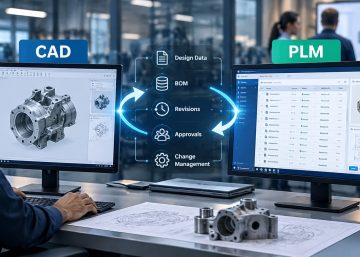
CAD and PLM perform different but complementary roles.
PTC Creo supports product design and engineering, while PTC Windchill provides a broader environment for managing product data and lifecycle processes.
Together, Creo and Windchill can support a connected engineering workflow.
A typical process may involve:
- Designing components and assemblies in Creo.
- Managing CAD data and revisions through Windchill.
- Creating and managing product structures.
- Reviewing and approving engineering changes.
- Controlling released product information.
- Making relevant information available to downstream teams.
This connection can reduce reliance on disconnected file-sharing processes and improve visibility into product information.
For organizations implementing digital engineering initiatives, integrating CAD and PLM is therefore an important step toward building a stronger Digital Thread.
PLM and Smart Manufacturing
Industry 4.0 extends beyond engineering.
Manufacturers also need to connect product information with manufacturing operations.
This creates the opportunity to connect PLM, ERP, MES, IIoT, analytics, and other enterprise systems.
A well-designed digital architecture can allow product information created during engineering to support downstream manufacturing processes while operational information can provide valuable feedback to engineering and product teams.
This creates a more connected product lifecycle.
For example, manufacturing feedback can help engineering teams understand how a product performs in real-world production environments.
Similarly, controlled engineering changes can provide downstream teams with accurate information about what needs to be manufactured.
The result is a more connected information flow across the enterprise.
ThingWorx and Industrial IoT for Industry 4.0
The Industrial Internet of Things (IIoT) is another important component of Industry 4.0.
PTC ThingWorx provides capabilities for developing and managing connected industrial applications and working with industrial data.
In a smart manufacturing environment, connected equipment can generate large volumes of operational data.
Organizations can use this information to improve visibility into:
- Equipment performance
- Production operations
- Asset conditions
- Maintenance requirements
- Operational efficiency
- Manufacturing performance
One important application is predictive maintenance.
Instead of relying only on fixed maintenance schedules or waiting for equipment failures, manufacturers can use equipment data and analytics to identify potential problems earlier.
This can help reduce unplanned downtime and improve asset utilization when appropriately implemented.
Real-Time Operational Intelligence
Manufacturing managers also need visibility into production performance.
Operational dashboards can help teams monitor manufacturing metrics such as Overall Equipment Effectiveness (OEE) and other production indicators.
When operational data becomes available in a timely manner, decision-makers can identify problems faster and respond based on actual production information rather than relying entirely on manual reporting.
This is one of the ways Industry 4.0 moves manufacturing from reactive decision-making toward more data-driven operations.
PTC Vuforia and Augmented Reality in Manufacturing
Technology alone cannot transform manufacturing. People remain a critical part of the process.
One of the challenges faced by manufacturing organizations is transferring technical knowledge from experienced employees to newer members of the workforce.
PTC Vuforia and augmented reality technologies can support this process by presenting digital information in the context of the physical environment.
Instead of relying exclusively on traditional manuals, technicians can potentially access visual instructions, 3D information, and guided procedures while working with physical equipment.
Applications can include:
- Equipment maintenance
- Assembly guidance
- Technical training
- Inspection procedures
- Remote assistance
- Service instructions
- Workforce knowledge transfer
For manufacturers dealing with increasingly complex products and equipment, AR can become another layer of the digital manufacturing ecosystem.
Bridging the Manufacturing Skills Gap
The manufacturing sector is experiencing a continuous need for technical skills and specialized knowledge.
Experienced engineers and technicians often possess valuable practical knowledge accumulated over many years.
The challenge is ensuring that this knowledge can be transferred effectively to the next generation of workers.
Digital work instructions and augmented reality can help organizations capture and communicate knowledge in a more visual and contextual manner.
This does not eliminate the need for skilled workers.
Instead, it can help workers access the right information at the right stage of a task.
For Indian manufacturing organizations expanding operations or modernizing existing facilities, workforce enablement should therefore be considered alongside technology implementation.
Cloud PLM and the Future of Digital Manufacturing
Cloud technologies are changing how organizations deploy enterprise software.
Traditional enterprise environments may require significant investment in infrastructure, administration, maintenance, and IT resources.
Cloud-based PLM approaches can provide an alternative deployment model for organizations looking to scale their digital capabilities.
Windchill+, PTC’s SaaS PLM offering, is part of this evolution toward cloud-based PLM.
For growing companies and organizations evaluating modern PLM architectures, cloud PLM can offer opportunities to simplify infrastructure management and support scalable digital processes.
However, technology selection should always be based on business requirements.
Before adopting a cloud PLM solution, organizations should evaluate factors such as:
- Product complexity
- Number of users
- Existing CAD environment
- ERP and enterprise integrations
- Data requirements
- Security requirements
- Compliance requirements
- Global collaboration needs
- Existing IT infrastructure
- Long-term digital transformation objectives
A successful PLM strategy is therefore not simply a software deployment exercise.
It is a business and engineering transformation initiative.
PLM Integration: Connecting the Digital Enterprise
PLM delivers greater value when it works as part of a connected enterprise architecture.
Manufacturers may need to integrate PLM with systems such as:
- ERP
- MES
- CAD
- CRM
- ALM
- IoT platforms
- Manufacturing systems
- Service applications
The objective is not to connect every system simply because integration is technically possible.
The objective is to establish reliable information flows between systems where integration creates measurable business value.
For example, PLM-ERP integration can help connect engineering product information with enterprise and business processes.
Similarly, PLM-MES integration can help create greater continuity between engineering information and manufacturing execution.
This connected approach supports the broader Industry 4.0 vision of a digital enterprise.
Why Indian Manufacturers Need a Strong PLM Strategy
Indian manufacturing is becoming increasingly integrated into global supply chains.
OEMs, suppliers, engineering organizations, and manufacturing companies need to manage growing levels of product complexity while maintaining quality, cost efficiency, and faster development cycles.
A strong PLM strategy can help organizations address several important challenges:
1. Better Product Data Management
Centralized and controlled product information can reduce confusion caused by multiple versions and disconnected files.
2. Improved Engineering Collaboration
PLM can provide structured processes for collaboration across engineering teams, manufacturing functions, suppliers, and other stakeholders.
3. Stronger Engineering Change Management
Controlled change processes can improve visibility into engineering changes and their downstream impact.
4. Greater Digital Continuity
Connecting product information across lifecycle stages helps establish a stronger Digital Thread.
5. Better Foundation for Industry 4.0
PLM can serve as an important foundation for broader digital transformation initiatives involving IoT, analytics, connected products, and smart manufacturing.
From PLM Implementation to Digital Transformation
Implementing PLM successfully requires more than purchasing software licenses.
Organizations should consider:
Business requirements → PLM strategy → Solution architecture → Data migration → System integration → User adoption → Training → Support → Continuous improvement
This is why choosing the right PLM implementation partner is important.
A successful implementation should align the PLM platform with the organization’s engineering processes, product structures, business requirements, integration landscape, and long-term digital transformation roadmap.
Companies may also require support for:
- PLM implementation
- PLM migration
- PLM upgrades
- PLM integration
- PLM customization
- PLM consulting
- PLM support
- CAD and PLM integration
- Engineering data management
The exact combination depends on the organization’s requirements and existing technology environment.
Building India’s Digital Factory Future
Industry 4.0 is ultimately about more than individual technologies.
It is about creating a connected manufacturing ecosystem in which people, processes, products, machines, and data work together.
PLM provides an important foundation by managing product information and lifecycle processes.
PTC Windchill can support product lifecycle management and Digital Thread initiatives. PTC Creo can support advanced product design and engineering. ThingWorx can support connected industrial applications and IoT initiatives. PTC Vuforia can support augmented reality and workforce enablement.
Together, these technologies can contribute to a broader digital engineering strategy.
For Indian manufacturers, the opportunity is significant.
Companies that establish reliable digital processes today can create a stronger foundation for innovation, operational efficiency, product development, and global competitiveness.
How Sumedhas Tech Solutions Can Support Your PLM Journey
Implementing a PLM platform is a strategic decision that should begin with understanding the organization’s current processes, technology landscape, product complexity, and business objectives.
Sumedhas Tech Solutions provides engineering software and PLM-related solutions for organizations looking to strengthen their digital engineering and product lifecycle capabilities.
Our areas of focus include:
- PLM solutions
- PLM implementation
- PLM integration
- PLM consulting
- PLM migration
- PLM upgrade services
- PLM support services
- PTC Windchill solutions
- PTC Creo solutions
- CAD and PLM solutions
- Engineering software solutions
- Digital engineering solutions
Whether your organization is evaluating PLM for the first time, modernizing an existing PLM environment, integrating engineering systems, or planning a broader digital transformation initiative, the right strategy should begin with your business and engineering requirements.
Ready to Build a Connected Digital Engineering Environment?
If your engineering, manufacturing, and product data are still managed across disconnected systems, it may be time to evaluate a structured PLM strategy.
Talk to Sumedhas Tech Solutions about your PLM, PTC Windchill, PTC Creo, integration, migration, upgrade, and digital engineering requirements.
Website: https://www.sumedhastech.com/
Contact: +91 70224 24601 | +91 90086 69121
Email: info@sumedhastech.com
Build a stronger Digital Thread. Connect engineering with manufacturing. Prepare your organization for the next stage of Industry 4.0.


You must be logged in to post a comment.