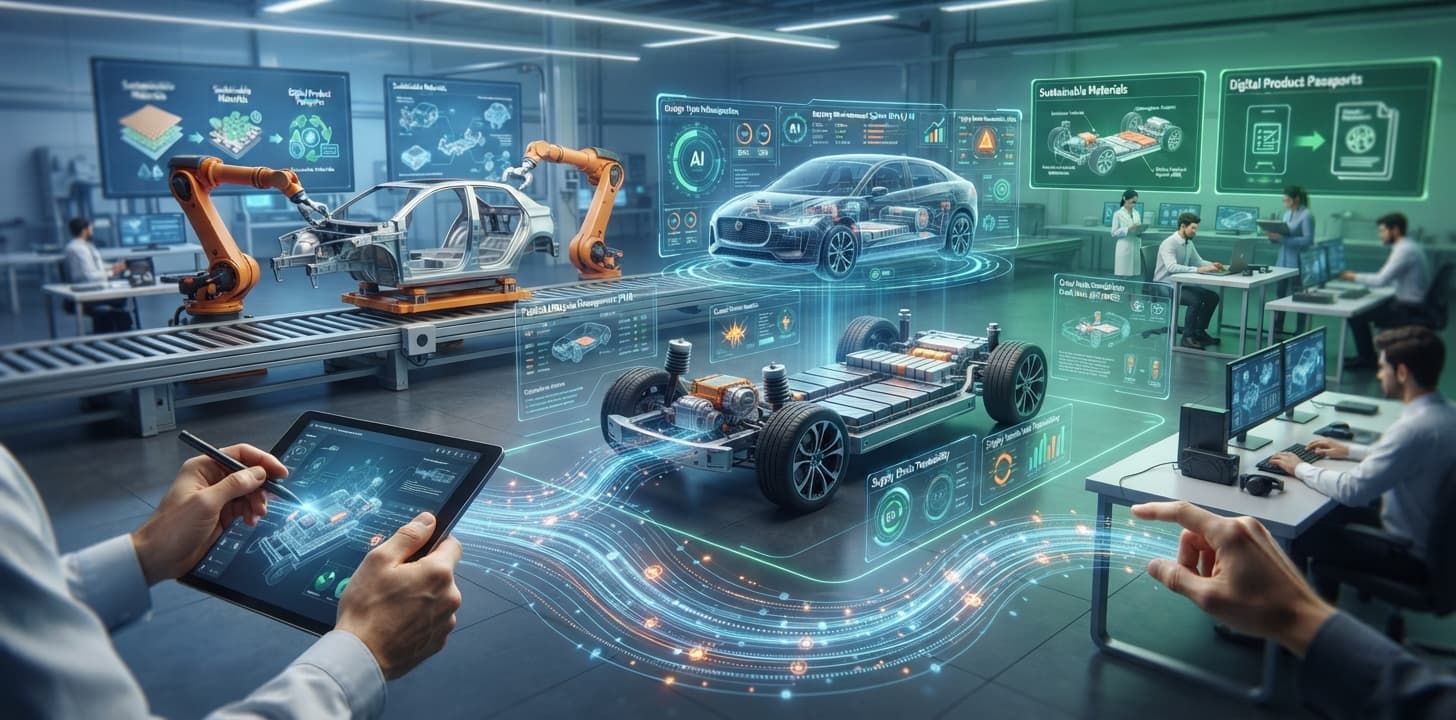
PLM Integration for Automotive Manufacturers: The Competitive Edge
The Indian automotive industry is undergoing a major transformation. Electric vehicles (EVs), software-defined vehicles (SDVs), advanced driver-assistance systems (ADAS), connected technologies, sustainability requirements, and increasingly complex supply chains are changing how automotive products are designed, developed, manufactured, and maintained.
For automotive OEMs, Tier-1 suppliers, and engineering organizations, managing product data across disconnected systems is becoming increasingly difficult. Engineering teams work with CAD and simulation data, manufacturing teams manage production information, software teams handle increasingly complex code and configurations, while business teams depend on ERP and other enterprise systems.
This growing complexity is making PLM integration for automotive manufacturers an important part of modern digital engineering and product development strategies.
A well-designed Product Lifecycle Management (PLM) integration strategy connects people, processes, applications, and product information across the complete product lifecycle. It can help organizations establish a connected digital thread from product concept and engineering through manufacturing, service, and end-of-life management.
For Indian automotive manufacturers competing in domestic and global markets, PLM integration can provide a structured foundation for improving collaboration, traceability, engineering change management, and product development efficiency.
Why PLM Integration Matters for Automotive Manufacturers
Automotive product development involves thousands of components, multiple engineering disciplines, suppliers, manufacturing facilities, software systems, and regulatory requirements.
Without an integrated environment, product information can become fragmented across spreadsheets, shared folders, CAD systems, ERP platforms, document management systems, and other enterprise applications.
This creates several challenges:
- Duplicate or outdated product information
- Limited visibility into engineering changes
- Delays in communicating design changes
- Difficulty maintaining product configurations
- Poor collaboration between engineering and manufacturing
- Limited traceability across the product lifecycle
- Increased dependency on manual processes
- Challenges integrating legacy enterprise systems
- Difficulty establishing a consistent source of product information
PLM integration addresses these challenges by connecting product-related information and processes across the enterprise.
Instead of treating engineering, manufacturing, procurement, quality, and service as isolated functions, an integrated PLM environment helps organizations establish a connected product lifecycle.
Creating a Single Source of Truth for Product Data
One of the most important benefits of PLM is the ability to establish a reliable source of product information.
Automotive organizations manage many forms of product data, including:
- CAD models
- Engineering drawings
- Bills of materials (BOMs)
- Product specifications
- Requirements
- Engineering change requests
- Engineering change orders
- Manufacturing information
- Supplier information
- Quality documentation
- Product configurations
- Software and system information
When these datasets are managed independently, teams may work with different versions of the same product information.
An integrated PLM environment helps synchronize relevant information and provides controlled access to product data based on organizational roles and processes.
This is particularly important when multiple engineering teams, manufacturing locations, suppliers, and external partners are working on the same vehicle or component program.
PLM and ERP Integration for Automotive Manufacturing
PLM and ERP systems serve different but complementary purposes.
PLM primarily manages product information, engineering processes, product structures, configurations, changes, and lifecycle information. ERP systems typically manage business processes such as procurement, inventory, production planning, finance, and enterprise operations.
For automotive manufacturers, connecting these systems can create a stronger digital foundation.
What Does PLM and ERP Integration Connect?
Depending on the organization’s architecture and business requirements, integration may involve information such as:
- Engineering BOMs
- Manufacturing BOMs
- Part master data
- Material information
- Product revisions
- Item attributes
- Change information
- Manufacturing data
- Supplier information
- Production-related information
The objective is not simply to connect two software systems.
The real objective is to create a controlled flow of accurate product information between engineering and business processes.
A properly planned PLM and ERP integration strategy can reduce manual data entry, improve information consistency, and help organizations establish better visibility across product development and manufacturing operations.
Building a Digital Thread Across the Product Lifecycle
The concept of the digital thread is becoming increasingly important in modern engineering.
A digital thread connects product information and processes across different stages of the product lifecycle.
For an automotive manufacturer, this can include:
Concept → Requirements → Design → Simulation → BOM → Engineering Change → Manufacturing → Quality → Service → End of Life
When these stages are connected, organizations can improve traceability and understand how a change in one part of the product lifecycle affects other processes.
For example, a change to an automotive component may affect the CAD model, engineering BOM, manufacturing BOM, supplier information, production process, documentation, and service information.
Without an integrated environment, tracking these relationships manually can be difficult.
With a connected PLM architecture, organizations can establish stronger relationships between product data, processes, and changes.
PLM Integration Challenges for Indian Automotive Manufacturers
Implementing PLM integration is not simply a matter of purchasing software and connecting systems.
Automotive organizations often operate complex technology environments that include legacy applications, customized enterprise systems, multiple CAD platforms, ERP solutions, manufacturing applications, and supplier systems.
Common challenges include:
Legacy System Integration
Many manufacturers have existing ERP, CAD, document management, and manufacturing systems that cannot simply be replaced.
A successful PLM strategy therefore needs to consider how existing systems will interact with the new PLM environment.
Data Migration
Historical product data can be one of the most difficult parts of a PLM transformation.
Organizations may need to migrate:
- Parts
- Documents
- CAD files
- BOMs
- Revisions
- Product structures
- Change history
- Attributes
- Legacy records
Data quality should be assessed before migration. Moving inaccurate, duplicated, or obsolete information into a new PLM environment can create problems rather than solve them.
Engineering Change Management
Automotive product development involves continuous changes.
A PLM solution should provide structured processes for managing engineering changes, approvals, revisions, configurations, and affected product information.
User Adoption
Technology alone does not create digital transformation.
Engineers, designers, manufacturing teams, quality teams, suppliers, and other stakeholders need clearly defined processes and appropriate training.
User adoption should therefore be considered an important part of any PLM implementation strategy.
The Role of PTC Windchill in Automotive PLM
For organizations evaluating enterprise PLM platforms, PTC Windchill is an important technology to consider for managing product data, product structures, configurations, changes, and lifecycle processes.
Windchill can support organizations looking to establish a structured product lifecycle environment across engineering and other business functions.
When integrated with existing engineering and enterprise applications, PLM platforms such as Windchill can become an important component of an organization’s broader digital engineering architecture.
For automotive manufacturers, the implementation approach should be based on actual business requirements rather than simply deploying every available PLM capability.
Key areas to evaluate include:
- Product data management
- BOM management
- Engineering change management
- Configuration management
- Document management
- Product collaboration
- CAD data management
- ERP integration
- Supplier collaboration
- Product lifecycle processes
A structured Windchill PLM implementation can help organizations create a scalable foundation for managing increasingly complex product development environments.
PLM Integration for Electric Vehicle Manufacturing
The transition toward electric mobility is introducing new engineering and manufacturing challenges.
EV development involves systems and components such as:
- Battery packs
- Battery management systems
- Electric motors
- Power electronics
- Thermal management systems
- Charging systems
- Embedded software
- Vehicle control systems
These components involve interactions between mechanical, electrical, electronics, and software engineering disciplines.
This increases the importance of managing relationships between requirements, systems, components, engineering data, and changes.
A connected PLM environment can help organizations manage product information across these disciplines and support greater visibility into complex product configurations.
For Indian automotive companies developing electric two-wheelers, passenger vehicles, commercial vehicles, and related components, a scalable PLM architecture can become an important part of a long-term product development strategy.
PLM and Software-Defined Vehicles
The automotive industry is increasingly moving toward software-defined vehicles, where software plays a central role in vehicle functionality.
Modern vehicles can involve:
- Embedded software
- Electronic control units
- Vehicle networks
- Connected services
- ADAS functionality
- Cybersecurity requirements
- Over-the-air software updates
This creates a product development environment where hardware and software cannot always be managed as completely separate disciplines.
Automotive organizations need stronger traceability between requirements, systems, hardware, software, testing, configurations, and changes.
PLM integration can contribute to this connected environment by helping organizations manage product information and lifecycle processes across engineering domains.
AI and Digital Twins in Automotive Product Development
Artificial intelligence and digital twin technologies are becoming increasingly relevant to digital engineering and manufacturing.
A digital twin can provide a digital representation of a physical product, system, or process and can be used to support analysis, simulation, monitoring, and optimization depending on the implementation.
For automotive manufacturers, digital engineering approaches can support activities such as:
- Virtual product validation
- Engineering simulation
- Manufacturing process analysis
- Performance evaluation
- Design optimization
- Predictive analysis
- Product configuration management
When PLM, CAD, CAE, simulation, manufacturing, and other engineering systems are connected, organizations can establish a stronger digital engineering ecosystem.
The value comes not from using AI or digital twins in isolation, but from connecting relevant product data and engineering processes throughout the lifecycle.
PLM Integration and Product Traceability
Traceability is increasingly important for automotive organizations.
Manufacturers need visibility into where product information originated, what changes were made, who approved those changes, and which products or configurations are affected.
An integrated PLM environment can support traceability across:
Requirements → Design → Parts → BOM → Changes → Manufacturing → Quality → Service
This becomes particularly valuable when products have multiple configurations, regional variants, suppliers, and engineering revisions.
Better traceability can also support quality processes, compliance activities, engineering investigations, and product lifecycle management.
Sustainability and Digital Product Information
Sustainability is becoming a more important consideration in product development and manufacturing.
Automotive manufacturers are increasingly expected to understand material usage, supply-chain information, product lifecycle impacts, recycling considerations, and other sustainability-related information.
PLM can play a role by connecting product information with lifecycle processes.
This can support approaches such as:
- Design for sustainability
- Design for recyclability
- Material traceability
- Lifecycle information management
- Product configuration tracking
- Circular product development
For Indian automotive manufacturers supplying global markets, the ability to manage reliable product information throughout the lifecycle can become increasingly important as sustainability and traceability requirements evolve.
Cloud-Based PLM for Automotive Companies
Cloud technologies are changing how organizations deploy enterprise software.
Cloud-based PLM can provide organizations with potential benefits such as scalability, centralized access, simplified infrastructure management, and easier collaboration across geographically distributed teams, depending on the selected architecture and implementation model.
For Indian automotive suppliers and engineering organizations operating across multiple locations, cloud-enabled PLM can be considered as part of a broader digital transformation strategy.
However, organizations should evaluate cloud PLM based on:
- Data security
- Integration requirements
- Performance
- Regulatory requirements
- User access
- Existing IT infrastructure
- Data migration requirements
- Total cost of ownership
- Long-term scalability
The right PLM deployment model depends on the organization’s technical architecture, business requirements, and transformation objectives.
How Automotive Manufacturers Can Approach PLM Implementation
A successful PLM implementation should begin with business processes rather than software features.
A practical approach can include the following stages:
1. Assess Existing Product Development Processes
Identify how product information currently moves between engineering, manufacturing, procurement, quality, suppliers, and other teams.
2. Identify Integration Requirements
Map the applications that need to exchange information with PLM, including CAD, ERP, simulation, manufacturing, and other enterprise systems.
3. Define the Product Data Model
Establish how parts, documents, BOMs, revisions, configurations, requirements, and changes should be structured and governed.
4. Develop the Integration Architecture
Define how PLM will communicate with ERP and other systems while maintaining appropriate ownership and governance of data.
5. Plan Data Migration
Assess legacy data quality and determine what information needs to be migrated, transformed, archived, or retired.
6. Implement in Phases
A phased implementation can help organizations validate processes, manage organizational change, and reduce implementation risks.
7. Measure Business Outcomes
Organizations should establish measurable objectives around areas such as engineering productivity, change management, data quality, collaboration, traceability, and product development efficiency.
Choosing the Right PLM Integration Partner
PLM integration can involve software architecture, engineering processes, data management, system integration, migration, customization, user adoption, and ongoing support.
Choosing the right PLM implementation partner is therefore an important decision.
Organizations should evaluate a potential partner based on factors such as:
- PLM implementation experience
- Integration capabilities
- Data migration expertise
- Engineering software knowledge
- ERP integration capabilities
- Customization and configuration expertise
- Upgrade and support capabilities
- Understanding of manufacturing processes
- Ability to scale the solution as business requirements evolve
For automotive OEMs and suppliers, the right partner should be able to understand both the technology and the underlying product development processes.
The Competitive Advantage of PLM Integration
The automotive industry is moving toward increasingly connected products and increasingly complex engineering environments.
For Indian automotive manufacturers, the competitive challenge is no longer only about designing a better vehicle.
It is also about how effectively the organization can manage product information, engineering changes, configurations, collaboration, manufacturing processes, suppliers, and lifecycle data.
PLM integration provides the foundation for connecting these elements.
When PLM is integrated with CAD, ERP, engineering applications, manufacturing systems, and other enterprise technologies, organizations can move closer to a connected digital product lifecycle.
This can support:
- Better product data visibility
- Improved engineering collaboration
- More controlled engineering changes
- Stronger product traceability
- Better integration between engineering and manufacturing
- Improved management of complex product structures
- Greater readiness for EV and software-defined vehicle development
- A stronger foundation for digital engineering
Conclusion
PLM integration for automotive manufacturers is an important component of modern digital engineering and manufacturing strategies.
Indian automotive OEMs, Tier-1 suppliers, and engineering organizations are operating in an environment where products are becoming more complex, software content is increasing, development cycles are becoming more demanding, and global market requirements continue to evolve.
A connected PLM environment can help organizations bring product data, people, processes, and enterprise applications together.
From PLM and ERP integration to digital thread, EV product development, PTC Windchill, digital twins, engineering change management, and product traceability, PLM can provide the digital foundation required to manage the modern product lifecycle.
The objective should not be to implement PLM simply because it is a modern technology.
The objective should be to build a connected, scalable, and governed product development environment that improves how engineering and manufacturing teams create, manage, and deliver products.
Transform Your Product Lifecycle with Sumedhas Tech Solutions
Sumedhas Tech Solutions provides PLM, engineering software, implementation, integration, consulting, migration, upgrade, and support services for organizations looking to strengthen their digital engineering capabilities.
If your organization is evaluating PLM integration, PLM implementation, PTC Windchill, PLM and ERP integration, or broader digital engineering solutions, our team can help you evaluate an appropriate approach based on your business and technology requirements.
Talk to Sumedhas Tech Solutions about your PLM requirements.
Phone: +91 70224 24601 | +91 90086 69121
Email: info@sumedhastech.com
Website: https://www.sumedhastech.com/
Build a connected digital product lifecycle for your next generation of automotive products.
You must be logged in to post a comment.