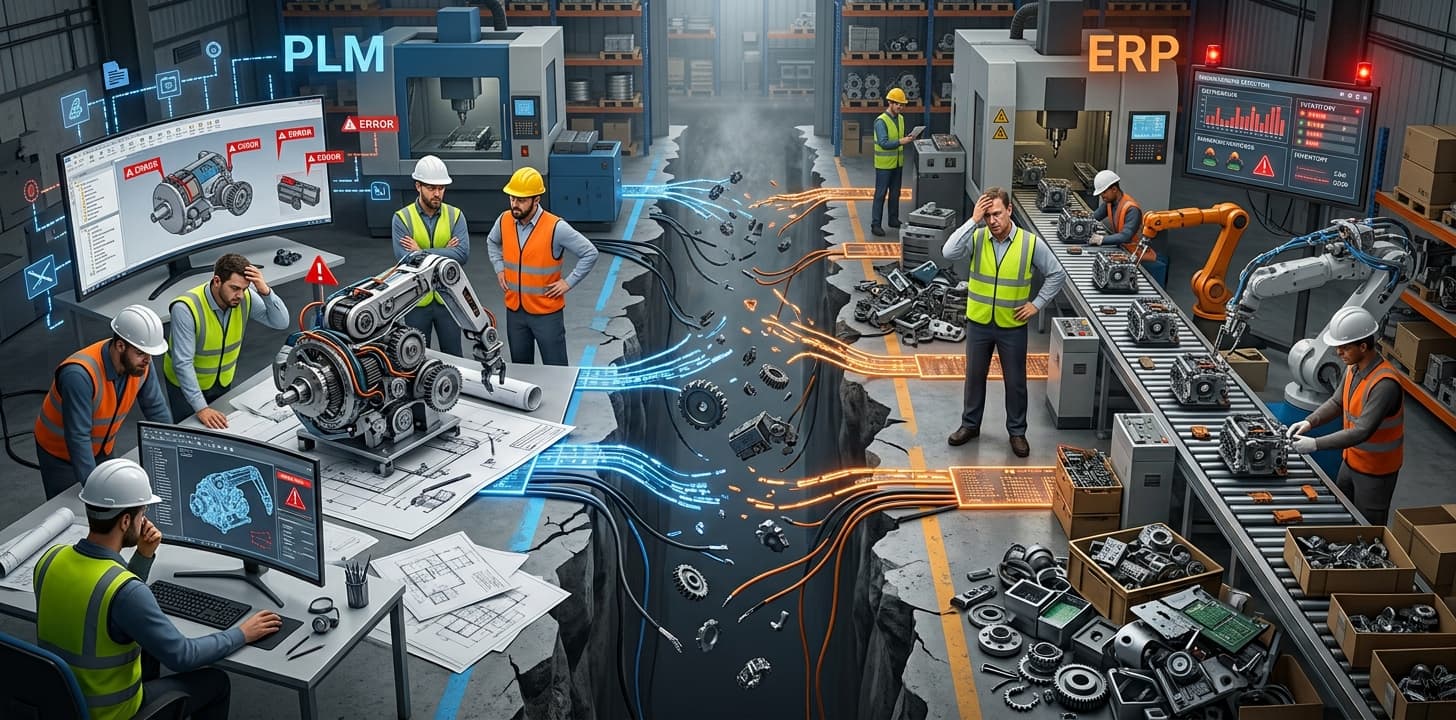
The Hidden Cost of Disconnected PLM and ERP Systems in Manufacturing
Imagine this: your design team updates a product, but production is still working on an older version. Procurement orders outdated components. Deadlines slip. Costs rise. And no one can pinpoint where things went wrong.
This is what happens when PLM and ERP systems operate in silos.
Many manufacturing companies don’t realize that the real cost isn’t just inefficiency—it’s lost revenue, rework, compliance risks, and missed opportunities.
Let’s break it down.
What Happens When PLM and ERP Systems Are Not Integrated?
Product Lifecycle Management (PLM) manages product design, engineering data, and revisions, while ERP systems handle procurement, inventory, and production.
When these systems don’t communicate:
- Engineering changes don’t reach production on time
- BOM (Bill of Materials) inconsistencies occur
- Procurement orders incorrect parts
- Teams rely on manual data transfers (Excel, emails)
According to industry research, companies lose 20–30% productivity due to poor data integration across systems.
The Real Business Cost of Disconnected Systems
1. Costly Engineering Change Errors
When updates from PLM don’t sync with ERP:
- Production may use outdated designs
- Scrap and rework increase
Even a single engineering error can cost thousands—or more—depending on production scale.
2.Delayed Time-to-Market
Manual coordination slows everything down:
- Approvals take longer
- Miscommunication delays production
A delay of even a few weeks can mean losing competitive advantage or customer trust.
Want to reduce delays in your product development cycle? Talk to our experts today.
3. Poor Inventory and Procurement Decisions
Without real-time data:
- Overstocking or stockouts become common
- Procurement teams work with inaccurate BOMs
This directly impacts cash flow and operational efficiency.
4.Lack of Visibility Across Teams
Disconnected systems create information gaps:
- Engineering, manufacturing, and procurement work in isolation
- Decision-making becomes reactive instead of proactive
Leaders lack a single source of truth.
5.Compliance and Quality Risks
In regulated industries, traceability is critical.
Without integration:
- Tracking product changes becomes difficult
- Audit readiness is compromised
This can lead to penalties, recalls, or reputational damage.
Let’s look into an example of how PLM & ERP integration makes a difference
A mid-sized manufacturing company faced repeated production delays. Their design team updated CAD models in PLM, but ERP still reflected older BOMs.
Result:
- Incorrect parts were ordered
- Production halted for corrections
- Costs increased by nearly 18% in a quarter
After integrating PLM and ERP:
- BOM accuracy improved
- Production delays reduced significantly
- Cross-team collaboration became seamless
Benefits of Integrating PLM and ERP Systems
Single Source of Truth
All teams access consistent, real-time data.
Faster Engineering Change Management
Changes flow automatically from design to production.
Improved Operational Efficiency
Reduced manual work and fewer errors.
Better Decision-Making
Leaders get complete visibility across product and operations.
Cost Savings
Less rework, fewer delays, and optimized inventory.
Companies that integrate PLM and ERP often report up to 25% reduction in operational costs.
Why Choose Sumedhas Tech Solutions for PLM Integration?
At Sumedhas Tech Solutions, we don’t just provide software—we deliver complete transformation.
What We Offer:
- Authorized PTC PLM licenses
- End-to-end PLM implementation services
- Seamless PLM-ERP integration
- Customization based on your business needs
- Ongoing support and training
As an authorized PTC license provider, we ensure:
- Genuine software solutions
- Scalable implementation
- Expert guidance at every stage
Book a free consultation with our PLM experts and see how integration can streamline your operations.
How We Help You Get Started
Our approach is simple and effective:
- Understand your current challenges
- Identify gaps between PLM and ERP systems
- Design a tailored integration strategy
- Implement with minimal disruption
- Provide continuous support
Schedule your free demo today and explore how integrated systems can improve your workflow.
Ready to Eliminate Data Silos?
Disconnected PLM and ERP systems silently impact your business—through inefficiencies, errors, and missed opportunities.
Integration isn’t just a technical upgrade—it’s a strategic move that brings clarity, speed, and control across your operations.
If your teams are still juggling between systems, now is the time to rethink your approach.
Take the first step toward smarter, connected operations.
- Get a Free Demo & Consultation with Sumedhas Tech Solutions today
- Discover how the right PLM integration can reduce costs and improve efficiency across your organization

You must be logged in to post a comment.